
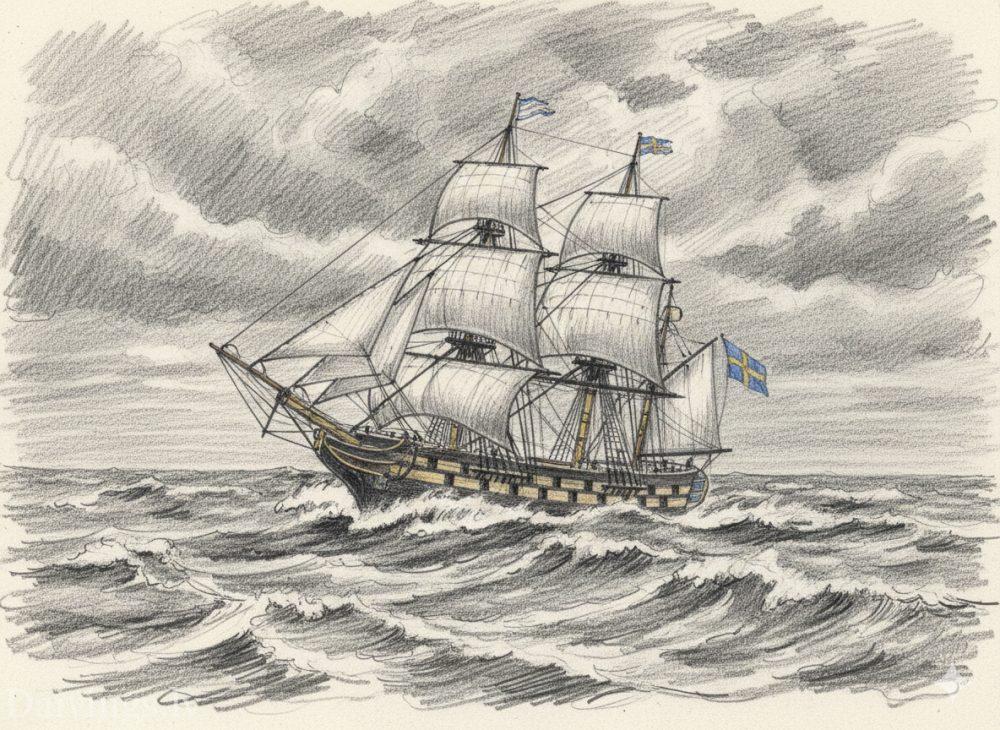
Exploring shipwrecks and searching for treasure requires top-notch technical knowledge and engineering precisionThis story is about a Swedish schooner. "Jönköping", which was sunk in the Baltic Sea by a German submarine in 1917. The salvage expedition, which began almost eighty years later, became a showcase of deep-sea diving and heavy lifting engineering, uncovering a cargo that turned out to be one of the most valuable finds on the seabed.
Wreck discovery, technical investigation and cargo manifest specifications
In 1997 the shipwreck was located 64 meters in depth, using side scan sonar technology. Another wreck was also found during the search – a Swedish steamer Ägir, which was sunk on the same day by the same submarine, but this time the focus was solely on the “Jönköping” and its unique cargo. Trimix divers found that the hull was perfectly preserved in one piece, the cold and dark environment of the Baltic Sea provided excellent protection. Damage was minimal – downed masts and a small hole caused by the scuttling carried out by German submarine U22 crew.
The reason for the search for the wreck was the ship's main cargo, which was intended for Russian army officers. The cargo list included 4400 bottles 1907 Heidesieck Champagne “Goût Americain”, 67 large barrels cognac (approximately 5,000 gallons or 25,000 bottles) and 17 regular barrels of wine. The champagne bottles that were initially recovered were opened and reportedly tasted great. The diving team hoped that the cognac barrels would also be airtight.

Deep Sea Challenge and Trimix Diving
The fact that the ship was at a depth of 64 meters greatly complicated the operation, requiring a transition to technical diving. Working at such a depth requires Trimix – a special breathing gas mixture consisting of oxygen, nitrogen and helium. The addition of helium is critical to reduce nitrogen narcosis (which becomes dangerous at depth) and oxygen toxicity impact, allowing divers to perform precise tasks.
Decompression protocols and safety
The deep-sea environment was slow and dangerousThe water temperature was freezing and visibility was poor. To reduce the risks, divers were only allowed to work on the bottom of the wreck. 15 minutes at a time. Then they had to rush immediately with diving lift on the surface ship recompression chamberTo prevent caisson disease, caused by the formation of nitrogen and helium bubbles in the blood, divers had to spend up to 6 hoursby slowly reducing the pressure under controlled conditions.
Deep-sea environment and conservation factor
The depths of the Baltic Sea created ideal conditions for preserving champagne. At a depth of approximately 64 meters, there is a constant, low temperature, which is from 2°C to 4°C all year round. These conditions, which are similar to for an excellent wine cellar, effectively halted the maturation process of champagne, which would otherwise have happened much more quickly in the heat. Thanks to the low temperatures and darkness, the drink remained almost unchanged for 80 years.
Engineering salvage operation: ship lifting
Given the high costs and time constraints of deep-sea diving, a radical engineering solution was developed: the ship had to be moved closer to the surface.
- Tunneling: Divers worked to create tunnels under the ship's hullso that heavy loads can be wrapped around it steel cables.
- Lifting: Was brought to the place giant floating crane (almost 30 meters high), which was a big challenge in the open sea.
- Moving the wreck: The crane slowly lifted the Jönköping off the bottom and held it in place for about 1 meter below the water surfaceThis step drastically facilitated lifting the cargo from easily accessible depths.
Cargo surprise: cognac vs. champagne
After lifting, rescuers began to remove barrels and bottles, but were in for a big surprise regarding their state of preservation:
- Cognac: Soft oak barrels had deteriorated. Seawater had slowly seeped through the wood, replacing cognac with salt water. Unfortunately, most of the contents of the 67 barrels were irreparably damaged.
- Champagne: Unlike barrels, glass bottles and the cold environment had proven to be an ideal means of preservation. The prestigious champagne, which experts considered undrinkable, was in excellent quality.
The cork problem and the innovative solution
Even after lifting, there were technical difficulties with the champagne bottles caused by a decrease in water pressure:
- Pressure imbalance: At 64 meters, the external water pressure was almost identical to the pressure inside the bottle, thus holding the cork in place even if the retaining wires (muselet) had rusted.
- Cork removal: As the bottle rose, the external pressure dropped dramatically, allowing the internal gas pressure to to uncork.
- Innovative Solution: To prevent the corks from flying out, rescuers developed a quick and innovative method: as soon as the bottle was lifted, a wire mesh, which was quickly reinforced by strong wire, thus mechanically preventing the cork from being lost and the drink from spoiling. Thanks to this quick action, more than 2,000 bottles of champagne were saved.
Conclusion
The Jönköping salvage operation revealed that underwater treasure hunting is a high-tech industry. The project demonstrated the engineering ability to adapt to extreme conditions, starting with Trimix use to overcome great depths, ending with the array floating crane effective use.
In the end, contrary to initial expectations, not cognac, but perfectly preserved 1907 Champagne The cargo became a trophy worth millions, which continued its existence in cold storage warehouses, waiting for buyers. As expedition leader Klaus Berval said: “When you decide to go after something, you have to do it to the bitter end.
There is no other way.”Exploring shipwrecks and searching for treasure requires top-class technical knowledge and engineering precisionThis story is about a Swedish schooner. "Jönköping", which was sunk in the Baltic Sea by a German submarine in 1917. The salvage expedition, which began almost eighty years later, became a showcase of deep-sea diving and heavy lifting engineering, uncovering a cargo that turned out to be one of the most valuable finds on the seabed.


