
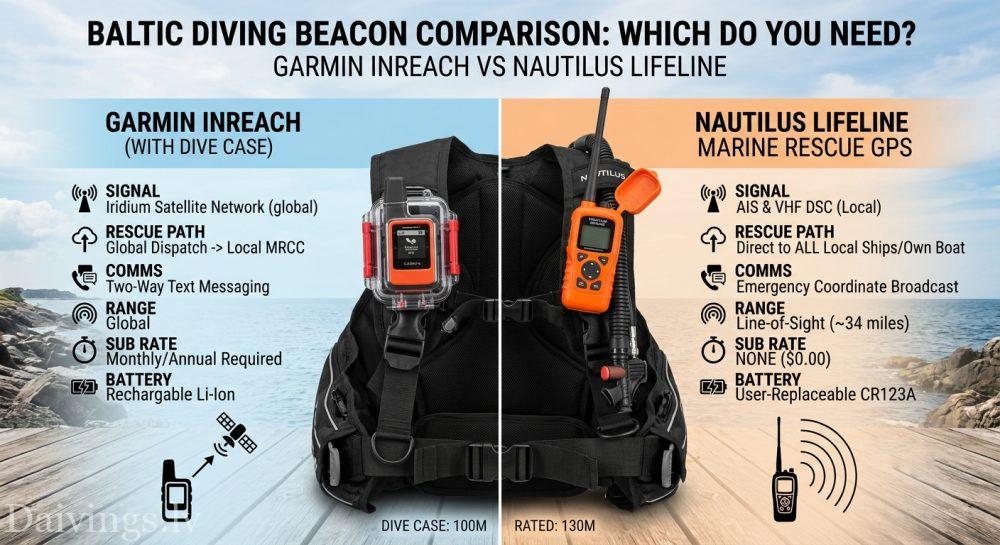
Garmin inReach vs. Nautilus Lifeline: Which emergency beacon to choose for diving in the Baltic Sea?
Safety beacons (PLB or Personal Locator Beacon) choice in the Baltic Sea is not simply a theoretical question of brands. It is the mathematics of survival. The harsh reality of the Baltic Sea – low water temperatures (even in summer below the thermocline), variable and strong surface currents, limited visibility and intense commercial shipping – dictate strict rules. If the current takes you away from your RIB, every minute becomes crucial.
In this article, we will technically compare two of the most popular, yet fundamentally different, surface security systems: Garmin inReach (satellite communicator in a special diving body) and Nautilus Lifeline Marine Rescue GPS (local AIS/VHF transmitter).
1. Technological architecture: How do they work?
The main difference between these two devices is physical signal path from the moment the diver surfaces and activates the alarm.
Nautilus Lifeline: Local AIS and VHF DSC radio wave
Nautilus operates on marine navigation frequencies ($161.975\text{ MHz}$ and $162.025\text{ MHz}$). Upon activation, the device uses the built-in GPS to determine your coordinates and immediately begins transmitting two types of signals:
- AIS (Automatic Identification System): Your location appears as a “man overboard” (MOB) target on the chartplotters and radars of all nearby vessels and your boat.
- VHF DSC (Digital Selective Calling): A digital alarm signal is sent to the marine radios of nearby ships, causing them to sound a loud alarm.
Garmin inReach: Global Iridium Satellite Network
Garmin inReach (e.g. Mini 2 model, housed in the manufacturer's $100\text{ m}$ waterproof case) operates as a two-way satellite communicator. It does not directly interface with marine radios or AIS systems. When activating SOS, the signal travels up to Iridium satellites in low Earth orbit, from them to a ground station and further to Garmin Response global coordination center in the USA.
2. Technical comparison
| Technical parameter | Garmin inReach (Dive Case) | Nautilus Lifeline GPS |
| Transmission technology | Satellite (Iridium network) | AIS and VHF DSC (Line-of-sight) |
| Operating radius | Global (pole to pole) | Up to ~34 nautical miles (depending on receiver antenna height) |
| Communication method | Two-way (text messages, statuses) | One-way emergency broadcast |
| Maximum depth | $100\text{ m}$ (in a special Garmin case) | $130\text{ m}$ (with lid closed) |
| Maintenance costs | Monthly/annual satellite subscription | $0.00\text{ EUR}$ (no fees) |
| Battery life | Rechargeable Li-Ion (cycles must be monitored) | Replaceable CR123A (lasts up to 5 years) |
3. Specifics of the Baltic Sea: Which solution wins in real conditions?
To understand which device is more suitable in our waters – for example, when diving in the Irbe Strait, near Liepāja, or in the deep shipwrecks opposite Jūrmala – two scenarios need to be evaluated.
Scenario A: “Lost on the Surface” (Time-to-Rescue Factor)
In the Baltic Sea, the water temperature at the surface rarely exceeds +18°C even in summer, but in spring/autumn or in windy weather it is dramatically lower. Hypothermia is the biggest enemy.
- With Nautilus Lifeline: As soon as you pull out the antenna and press a button, your own dive RIB boat (if equipped with a modern AIS receiver/plotter, which is standard for technical dive support vessels) sees immediately your location, direction and distance in meters. You are also immediately visible to all passing commercial ships in the busy Baltic shipping lanes. Rescue can occur within minutes.
- With Garmin inReach: SOS signal arrives Garmin Response They identify your coordinates and contact the regional rescue service – in the case of Latvian waters, the Coast Guard Maritime Search and Rescue Coordination Centre (MRCC Riga). It can take up to an hour or more for MRCC Riga to process the request, contact your designated contacts, and dispatch a rescue vessel or helicopter. Your own boat on the water will not even know that you have activated the SOS unless they have a second inReach device to receive the message.
Winner: Nautilus LifelineLocal AIS provides immediate response from those closest to you.
Scenario B: Accident or change of plans (No panic)
Not every situation is a matter of life and death. Let's say you're being carried away by the current, you can see your boat but it can't hear you or see you in the waves. You're safe and sound, just drifting.
- With Nautilus Lifeline: You have no right to press the button unless there is a real danger to life, as the AIS MOB signal will wake up all ships and the Coast Guard. There is no middle ground – either silence or a full-scale emergency signal.
- With Garmin inReach: This is where the biggest advantage of inReach comes in – two-way satellite text messagingYou can send a pre-written or free text message to the captain's phone or another inReach: "We were carried 1km north, everything is fine, we are waiting for the buoy." No need to call a helicopter, no need to disturb the Coast Guard.
Winner: Garmin inReachThe ability to communicate in non-standard situations without “Emergency” status is a huge advantage.
4. Technical details and operation
Housings and mechanical strength
- Nautilus is designed specifically for divers. It does not require an additional housing. It attaches to a BCD or drysuit pocket. A mechanical switch and cap ensure that the pressure will not compress it even at depths of $100+\text{ m}$.
- Garmin inReach is a land-based device ($IPX7$). To dive with it, you must purchase a special Garmin Dive CaseThis means extra volume and two extra O-rings that need to be checked and serviced before every dive. If the case floods, the inReach is lost.
Battery logistics
- In the Baltic waters, the cold quickly kills batteries. Nautilus uses CR123A batteries, which have excellent low temperature resistance and low self-discharge. They can last in the device for years and will work at the critical moment.
- The Garmin inReach has a built-in lithium-ion battery. If you forget to charge it before going out to sea, the device will be useless. It requires regular management.
Summary: What to choose for daivings.lv readers?
The choice depends on your diving profile and the existing equipment fleet on the boat:
- Choose Nautilus Lifeline if:
- Your primary goal is pure safety and a quick rescue to the surface.
- You dive from organized dive boats (RIBs) that have AIS receivers on board.
- You don't want to pay monthly subscription fees for a device you'll hopefully never use.
- Choose Garmin inReach (with Dive Case) if:
- You already use inReach for land expeditions, hiking, or hunting (so the subscription is already paid for).
- You are diving in remote areas without heavy boat traffic and want the ability to send a message to your hosts or captain: “Everything is fine, we are on the surface.”
- Your support team on shore or on the boat has a second compatible device for direct communication.
Safety tip: Regardless of the device you choose, always use a bright, at least $1.8\text{ m}$ long buoy (SMB) and a powerful strobe/flashlight in the Baltic Sea. Technology saves lives, but only if you know how to properly combine it with classic safety features.
1. Will my Nautilus Lifeline signal actually appear on our own RIB screen?
Answer: Yes, but on one condition: your boat must be equipped with AIS receiver, which is connected to a chartplotter (e.g. Simrad, B&G or Garmin). When Nautilus is activated, it broadcasts the standard AIS Marine Distress message. A red circle with a cross (MOB or I'm Overboard symbol) and a beep will sound, indicating the exact direction and distance to you. Before going to sea, always make sure that the AIS system on the captain's boat is turned on and configured for reception.
2. What happens if I accidentally press the SOS button on my Garmin inReach device while at sea?
Answer: In the case of Garmin inReach, nothing happens instantly, as the button is protected by a mechanical cover and the system requires confirmation on the screen. However, if a false alarm is sent, SOS can be canceled manually through the device menu. If the alarm is not canceled, Garmin Response The center will immediately contact the Latvian Coast Guard (MRCC Riga). If you realize this is a mistake, immediately use inReach two-way messaging to text the operator: “False alarm, all safe” (False alarm, everyone safe) to prevent unnecessary dispatch of rescue ships and helicopters.
3. Can the Nautilus Lifeline be used as a regular walkie-talkie to talk to the captain?
Answer: No. Older Nautilus models (manufactured more than 8-10 years ago) provided voice communications on VHF channel 16, but the current model – Nautilus Lifeline Marine Rescue GPS – is digital transmitter only. It has no microphone or speaker. It only transmits digital data (GPS coordinates and MOB identifier) over AIS and VHF DSC frequencies. If you need voice communication without an emergency, the Garmin inReach text function (or a standard marine VHF radio in a waterproof case) is the right choice.
4. How long do the batteries of both devices last after activating them in water?
Answer:
- Nautilus Lifeline: Once activated, it transmits continuously at maximum power for approximately 24 hoursBecause it uses CR123A lithium batteries, they have excellent resistance to the cold water of the Baltic Sea.
- Garmin inReach Mini 2: Battery life depends on how often the device sends GPS points (for example, every 10 minutes). In standard mode, it can transmit up to several daysHowever, it should be noted that at low temperatures the capacity of the built-in lithium-ion battery decreases more rapidly than that of Nautilus lithium batteries.
5. Do I need a special license or registration to use Nautilus in Latvia?
Answer: Internationally and in Latvia Nautilus Lifeline is classified as rescue equipment (MOB device) and has no need to pay a monthly subscription or register a permanent MMSI number, as is the case with large marine PLB beacons. The device is already assigned a unique nine-digit identification number at the factory, starting with “972…”, and is ready to operate immediately after removing it from the packaging and inserting the batteries.


