
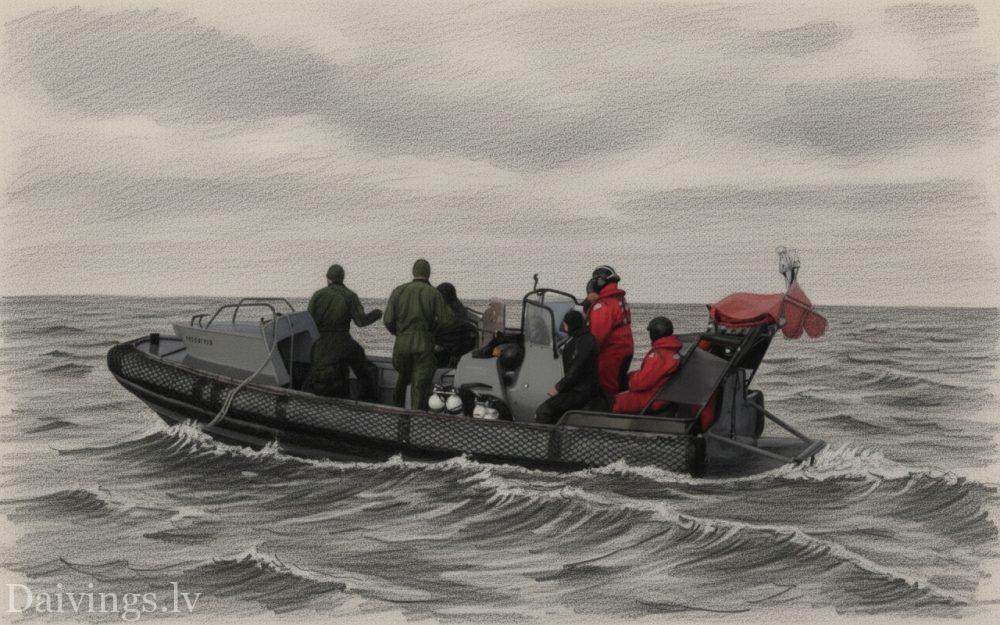
The Baltic Sea, which served as a strategically important region for both the Russian Empire and the Soviet Union, still hides thousands of dangerous relics of the First and Second World Wars – sea mines. These “treasures” pose a constant threat to shipping, the environment and human safety. That is why NATO’s First Mine Countermeasures Group regularly conducts international exercises aimed at finding and neutralizing these explosive objects, while protecting critical underwater infrastructure.
Historical heritage in the Baltic Sea
The mines on the Baltic Sea floor are mostly located in Smiltė, at a depth of about 20 meters. Although they do not move, their danger has not diminished. Different sources mention different numbers, but it is clear that there are still thousands of mines in the waters of the Baltic Sea. Most of them have been found in strategic locations, for example, at the entrance to the Baltic Sea between Denmark and Norway, in the Irbe Strait off the coast of Latvia and in the Gulf of Finland. The density of mines is particularly high in the Gulf of Finland, which during World War II was the route to St. Petersburg, where the USSR Baltic Fleet was based. Sea cleaning is an ongoing process to reduce the threat.
International cooperation in mine action
Cleaning the Baltic Sea is an international task. The video provides an insight into the work of the Lithuanian Navy divers and Finnish Navy specialists off the coast of Latvia, searching for and neutralizing mines. Until December, the Latvian Navy ship “Virsaitis” is leading the first NATO mine countermeasures group. Cooperation between the participating countries is described as smooth and efficient, and the command centers are doing an excellent job ensuring navigation safety.

Mine detection process and technologies
Minesweeping begins with careful planning, determining the number of divers needed and the unmanned aerial vehicles to be used. Suspected areas are then surveyed using sonar. Autonomous underwater vehicles (AUVs) are used, which are not drones, but unmanned aerial vehicles (UAVs) that scan the surrounding area with side-scanning sonars. These advanced devices can scan a much larger area of the seabed than a diver could. After the sonar is removed from the water, the data is analyzed to identify potentially dangerous objects.
The role of divers and the use of explosives
Once the sonar has identified a suspicious object, the divers, who usually work in pairs, begin their work. Their task is to visually identify, fix and record the location of the mines. There are many different objects under the water – from cannon barrels and interestingly shaped rocks to shipwrecks and fragments of mine weights, but the mines are still the most valuable finds. If a mine is found, the preparation of explosives and the actual detonation are planned. Finnish specialists add explosives to the mine using a remotely controlled yellow robot, allowing the detonation to be carried out from a safe distance.

Various finds on the seabed
Although the main task is to remove mines, the seabed also hides other objects. For example, during one 48-hour sonar mission, six mines were found, as well as about 90 pieces of the weights used to place the mines, which are not explosive in themselves. Various interesting rocks, boxes and objects from ships are also examined. Every suspicious object that resembles a mine must be examined, although experts do not hide the fact that finding rocks that resemble mines is not as pleasant as discovering a real mine.
Critical infrastructure protection
In addition to mine search and destruction, the NATO Naval Command assigns the ships to perform the Baltic Watch mission. This mission includes the protection of critical infrastructure located on the Baltic Sea floor, such as submarine cables. Any NATO military ship has the right to inspect suspicious vessels that are near these objects or are performing suspicious maneuvers. The crew of the ship “Virsaitis” has not yet had any cases when any ship refused to cooperate.
Shadow Fleet Surveillance and Risks
NATO also monitors so-called “shadow fleet” ships – those linked to sanctions or engaged in suspicious activities. The checks usually involve radioing the ship’s crew, asking questions about the route and flag to ensure that the information provided matches what is on file.
Suspicious vessels that pass through critical infrastructure or suddenly stop are given special attention. One of the most high-profile incidents occurred when the Estonian Navy tried to inspect the Gabonese-flagged Russian oil tanker Jaguar near the Estlink cable connecting Estonia and Finland. In response to the Estonian military presence, Russia sent SU-35 fighter jets, illustrating the tensions in the region.
Conclusion
The new reality in the Baltic Sea requires a dual approach to ensuring security. While one part of the team, using modern technology and the work of divers, frees the sea from the legacy of war - mines, the other part performs the Baltic Watch mission, monitoring maritime traffic and trying to prevent any damage to critical underwater infrastructure. This professional work ensures navigation safety and the future cleanliness and stability of the Baltic Sea.
Technologies used in mine hunting: sonars and autonomous underwater vehicles
Mine search and neutralization work in the vastness of the Baltic Sea would not be possible without modern autonomous systems and sonar technologies that are capable of scanning the seabed over a much larger area than divers.
Although the video does not mention specific manufacturers and model names, the types and functions of the equipment used were described in detail:
1. Sonar systems:
- Sonars: Generally cited as the primary means of scanning the surrounding area and identifying objects that could be mines.
- Side-scan sonar: It is used both as part of autonomous vehicles (in the case of the Lithuanian team) and when towed behind a ship (in the case of the Finnish team) to map the area and obtain a three-dimensional image of what is below the ship.
2. Autonomous and unmanned vehicles (AUV/ROV):
- Autonomous underwater vehicle / Unmanned aerial vehicle: Used to survey suspicious areas. Lithuanian specialists use it to carry out a mission, after which the data is entered into the system for analysis. It is not a drone, but a type of device that relies on previously entered data.
- Orange Robot (Autonomous Device): An autonomous device used by the Finnish Navy that is given a task and continues to perform its mission underwater independently. The data it obtains is processed and integrated into various systems.
- Yellow robot (Remote control system): This robot is used to identify potentially dangerous objects and is crucial in mine neutralization. Unlike their Lithuanian colleagues, Finnish specialists use this remotely controlled device to attach and detonate explosives to the mine, ensuring a high level of safety.


