
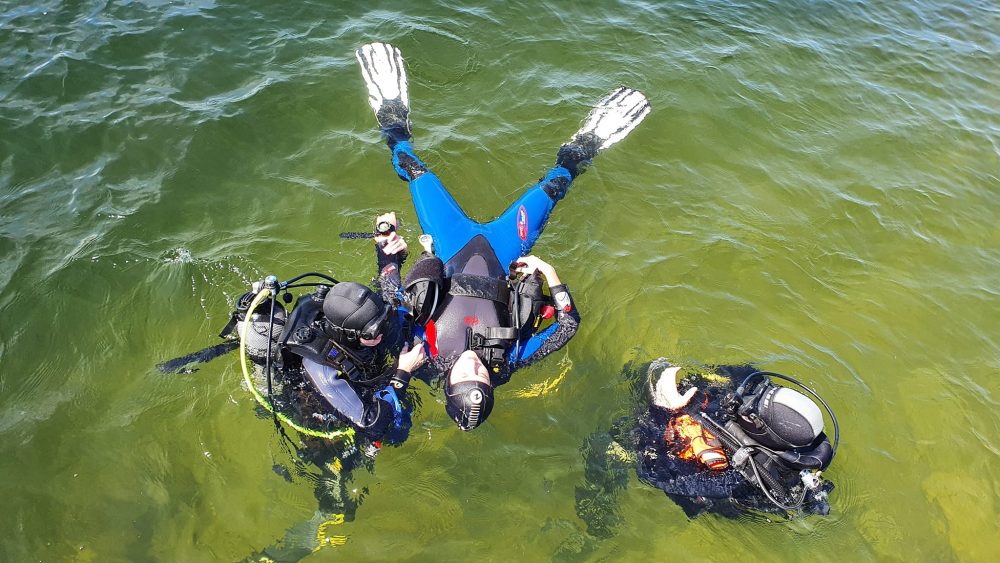
The underwater environment is fascinating, but it requires respect and constant preparedness for emergencies. Air crash (Out of Air) is one of the most serious situations a diver can experience. Only confident, instinctive and controlled action can save a life, PADI MSDT Valters Preimanis recommends, undergoes training PADI Rescue in the diver course.
This article reminds and systematizes the main steps to take if you or your partner (Dive Buddy) runs out of gas.
Stage 1. Recognition and panic control
The key to survival is one: Controlled action, not panic.
When the regulator suddenly stops or breathing becomes impossible, your body will react with instinctive panic. Your task is to consciously suppress it:
- Check the pressure gauge: First, make sure the cylinder is really empty. A look at the pressure gauge (SPG) will confirm this fact and allow your brain to start solving the problem.
- Find your match: Immediately turn to your partner and make eye contact. He/she is your only salvation.
Stage 2. Buddy Breathing
This is standard procedure if the couple is nearby (within arm's length).

A. If you run out of air (victim role)
- Signal: Point to your mouth with one hand, indicating “Out of Air.” At the same time, point firmly at his mouth with the other hand. alternative air source (AAG or octopus).
- Get AAG: Grab the AAG hose pair, not just the regulator itself.
- Breath and stability: Breathe in slowly and deeply. Once your breathing is stabilized, hold on to your partner with a hand grip.
- Signal takeoff: When you are ready, signal the pair “Up” (Thumbs up).
B. If the couple runs out of air (rescuer role)
- Rate: You see the sign “I’m out of air.” Make eye contact immediately.
- Offer AAG: Immediately give the couple your alternative air source (AAG) rather than your main regulator. It is best to offer the AAG from below (over the top) because it is most visible and is located in the diver's chest area.
- Control buoyancy: Your task is to control the buoyancy of both and initiate a controlled emergency takeoff.
- Start the ascent: Ensuring that both are breathing, begin a slow ascent, remembering to regulate your buoyancy (BC).
Phase 3. Controlled take-off (CESA)
If a couple is not available, the only option is Controlled emergency float takeoff (Controlled Emergency Swimming Ascent, CESA). This procedure may only be performed from for relatively shallow depths (no more than 9-18 meters), where the surface is quickly reached.
| Step | Description | The aim |
| 1. Drop the scales | Disconnect the scale belt/integrated scales. | Provides positive buoyancy. |
| 2. Look up | Bending your head to see the surface. | Protection against obstacles. |
| 3. Constant exhalation | CRITICALLY IMPORTANT! Exhale steadily and evenly, making an “Aaaaaahhh” or “Huuuuuuh” sound, even if the balloon seems empty. | Prevents air from expanding in the lungs and prevents pulmonary barotrauma (rupture). |
| 4. Swimming | Swim upwards, controlling your speed. | Make sure the speed is not too high. |
| 5. Controlled speed | Take-off speed must not exceed 9 meters (30 feet) per minute, even in the event of an emergency (unless it is CESA). | Prevents decompression sickness. |
Export to Spreadsheets
Conclusion: Training and proper maintenance of diving equipment
The only difference between disaster and salvation is training. Regularly repeat these emergency procedures with your partner during training dives:
- Make sure your AAG is easy to find (triangular area near the chest).
- Always dive with a partner (Buddy System).
- Perform regular equipment maintenance.
Be safe and enjoy your dives! Check it out! PADI Rescue course!


