
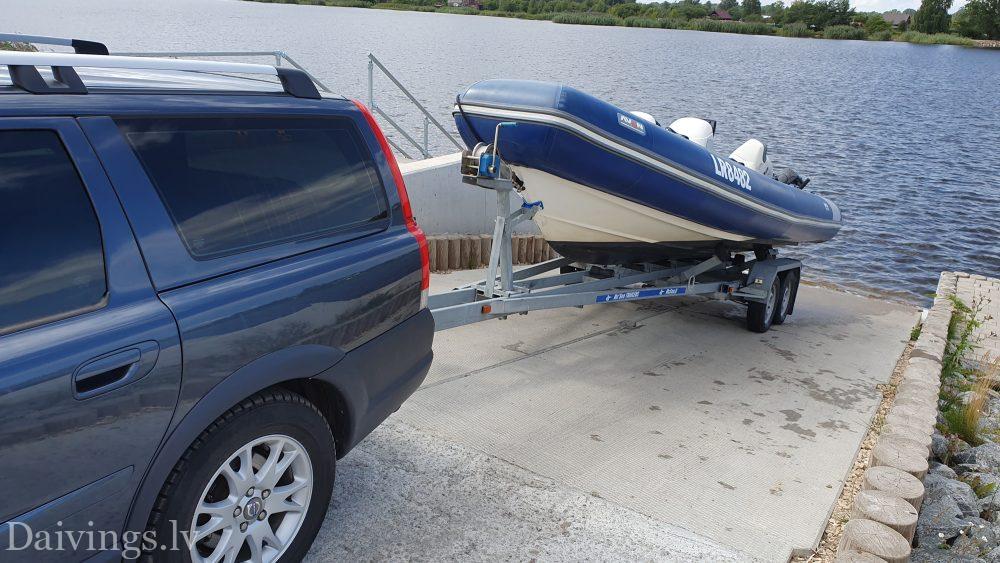
When you are at sea, especially in conditions of limited visibility or in areas of heavy shipping, “see and be seen”, AIS (Automatic Identification System), is not just a suggestion – it is life insurance. On diving trips, where the boat is often anchored or slowly drifting while the divers are underwater, AIS becomes a critically needed tool.
What is AIS and why is it needed?
AIS (Automatic Identification System) is an automatic identification system that operates in the VHF (ultra-shortwave) range. Unlike radar, which detects signals reflected from objects, AIS transmits and receives precise data:
- Vessel name and call sign.
- Accurate GPS coordinates, course and speed.
- The vessel's dimensions and status (e.g., "at anchor" or "restricted maneuverability").
The main benefits of a dive boat:
- Collision avoidance: Large ships see your small boat on their screens from 10-20 nautical miles away.
- Search and Rescue (SAR): In the event of an accident, the coast guard immediately sees your exact location.
- MMSI identification: Your boat becomes an official participant in maritime traffic.
Concept: AIS “Black Box” (KS-200A+)
In this tutorial we will use AIS Black Box approach. This means that the AIS device itself does not have a screen – it is a compact box hidden under the console, but the data is output to your existing chartplotter (Simrad, Lowrance, Garmin, etc.).
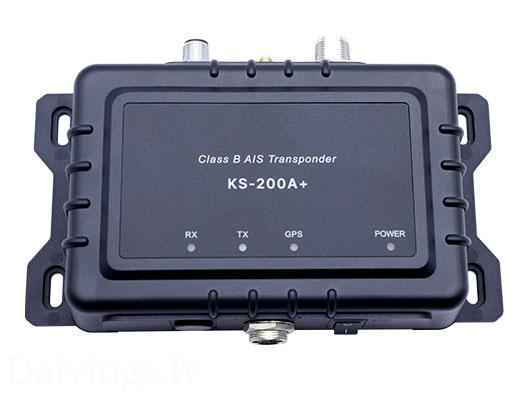
The heart of the system: Onwa KS-200A+
It is a Class B AIS transponder (both transmit and receive), which is a budget-friendly but reliable solution. The “+” version usually means an integrated GPS receiver.
Required equipment (Starter Kit)
For the system to work, you will need the following components:
| Component | Description |
| AIS Transponder | Onwa KS-200A+ (Black Box). |
| VHF Antenna | Separate antenna optimized for AIS frequencies (161.975 MHz and 162.025 MHz). |
| GPS Antenna | If the KS-200A+ does not have a built-in antenna, an external “mushroom” is required. |
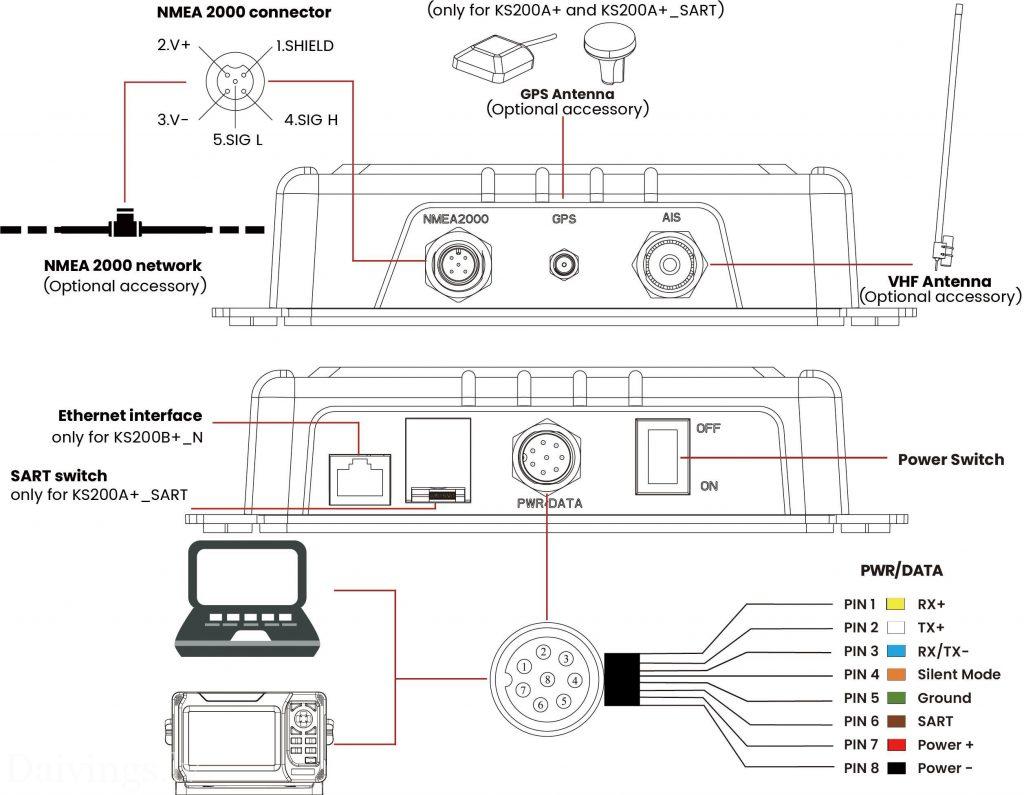
| NMEA 0183/2000 cables | For data transfer to the plotter. |
| Power cable | For 12V DC connection with fuse. |
Installation process: Step by step
Stage I: Antenna installation
AIS uses VHF waves that propagate “line of sight”.
- Height is important: Install the AIS antenna as high as possible (on a mast or targa).
- Distance: If the boat already has a radio, the AIS antenna should be at least 2 meters away from the VHF radio antenna to avoid interference.
- Cable: Use a quality coaxial cable (such as RG-58 or RG-213) and make sure the PL-259 connectors are hermetically sealed.
Stage II: Black Box assembly and power supply
- Location: Install the KS-200A+ in a dry, ventilated area under the console.
- Power supply: Connect to the 12V system on board. Be sure to use 2A or 5A fuse.
- Grounding: Make sure there is good contact to reduce static noise.
Stage III: Connecting to a chartplotter
Most KS-200A+ uses NMEA 0183 protocol.
- Connect the AIS “Transmit” (TX) wires to the plotter “Receive” (RX) wires.
- In the plotter settings (Settings -> Communications), select the appropriate port and set Enjoy Rate to 38,400 (High Speed). This is critical – the normal GPS speed (4,800) is not sufficient for AIS data flow.
Configuration and MMSI
AIS cannot just be turned on and driven. It must be programmed with your vessel's data.
- MMSI number: This is a unique 9-digit code assigned in Latvia. JSC “Electronic Communications”Without it, the device will only operate in reception mode.
- Data entry: Connect the AIS to the computer (using a USB-RS232 adapter), and with the manufacturer's software enter:
- Name of the ship.
- MMSI number.
- Ship dimensions (distance from antenna to bow/stern).
Conclusion
Installing AIS using the Black Box solution is the most efficient way to upgrade your dive boat. It doesn't take up space on your dashboard, but gives you a full overview of surrounding traffic on your chartplotter screen.
Important reminder: AIS does not replace vigilance and visual observation, but it is the best helper to get you and your crew back to shore safely.
Would you like a more detailed consultation? which one to buy AIS, write to us?


