
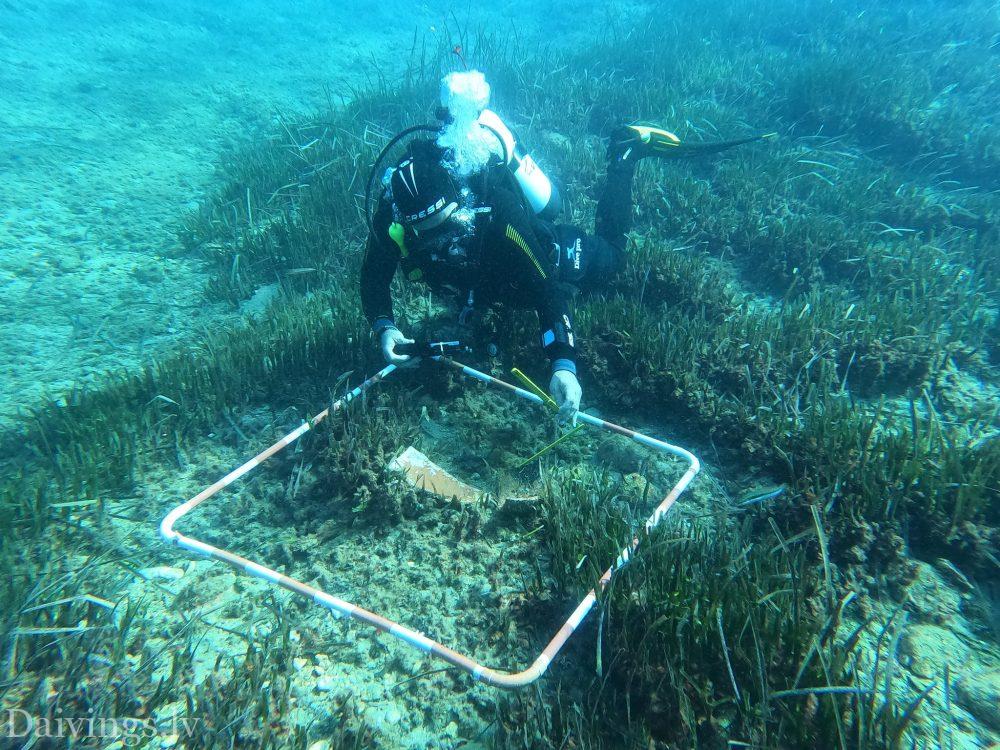
Underwater archaeology is not simply diving to wrecks; it is a complex science that studies the human past through material culture that has entered the hydrosphere. The main emphasis is placed on "in situ" (in its original location) the principle of preservation, which is determined by UNESCO 2001 Convention on the protection of underwater cultural heritage. An archaeologist-diver works with stratigraphy, which is often more fragile in an aquatic environment than on land, because sediments can be moved by currents.
Methodology and technological arsenal in underwater exploration
When working underwater, an archaeologist uses specific methods to record the spatial relationships of objects. Instead of using a conventional shovel, the dominant hydroejectors (water suctions) or air ejectors to gently expose artifacts from drifts.
- Bathymetry and side-scan sonars: Used for initial area scanning.
- Photogrammetry: Processing digital images to create accurate 3D models without physical contact with the object.
- Trilateration: A classic underwater measurement method to determine the precise coordinates of artifacts relative to a baseline.
Mandatory rules for working near cultural and historical sites
Work on underwater cultural and historical sites is strictly regulated to prevent bioerosion and mechanical damage. Main rules:
- Zero change: It is forbidden to move or lift artifacts without an agreed research project and immediate conservation plan (when removing an object from an anaerobic environment, it begins to degrade rapidly).
- Buoyancy control: An archaeologist must have perfect neutral buoyancy so as not to muddy sediments or damage fragile wooden structures with their flippers.
- Pre-intervention documentation: Any non-invasive research takes priority over excavation.
Advantages, why work underground?
Compared to their terrestrial counterparts, an underwater archaeologist has one huge advantage: anaerobic environment (lack of oxygen).
- Preservation of organic materials: In sediments, where oxygen is unavailable, wood, leather, textiles, and even food remains remain in near-perfect condition for centuries, while on land they would have decayed within a few years.
- Closed ecosystems: Shipwrecks often serve as “time capsules” – they provide a snapshot of a specific moment in history without the layers of later eras.
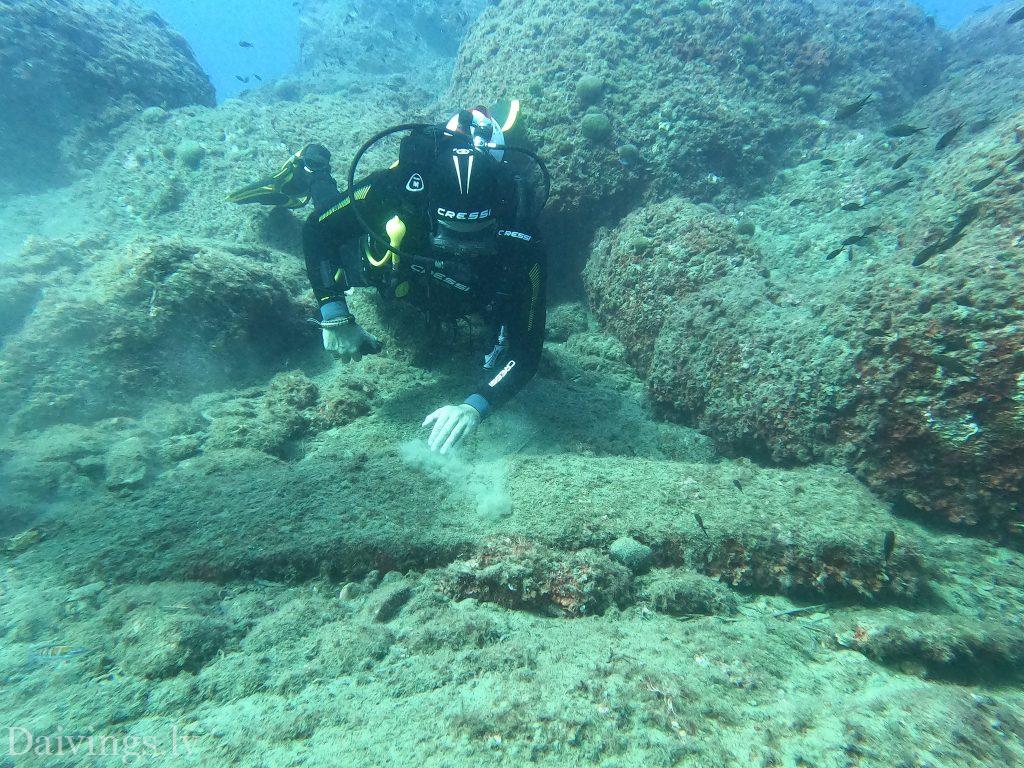
Certification is a path to professional exploration
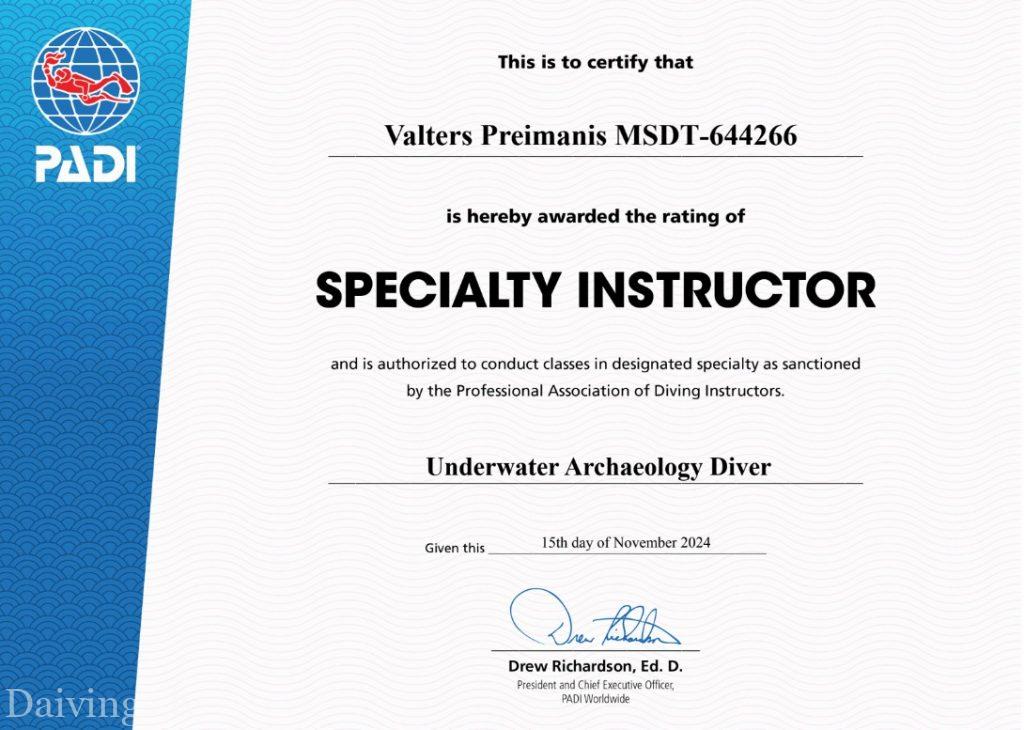
To become part of this community and legally work on archaeological expeditions, specific skills are required. It is possible to obtain an official, internationally recognized qualification in Latvia and beyond its borders. PADI Archeology Diver Specialty certificate.
This program provides basic knowledge about object surveying, documentation, and the legal framework.
Important: If you manage to complete Group of 4 people, training can be organized operationally both in local waters (for example, in the Baltic Sea, which is an excellent “storehouse” of wooden ships) and abroad. This certificate is the first step from an amateur to a researcher who understands that underwater history should be protected, not spent as souvenirs.
The most important additional courses and specializations necessary for professional activity
Technical diving and gas management
Archaeological sites are often located at depths that exceed the limits of recreational diving ($>30$ or $40$ meters), or require a long stay at the bottom.
- Enriched Air (Nitrox): Mandatory course to extend no-decompression limit, which is critically important when performing time-consuming surveying work.
- Deep Diver & Decompression Procedures: Necessary for working on wrecks located at great depths, where precise planning of decompression stops is required.
- Trimix: If the exploration takes place at even greater depths, where the risk of nitrogen narcosis must be reduced.
Precise buoyancy and operational safety
In archaeology, “to swim well” means “to stay still.”
- Peak Performance Buoyancy: This course is fundamental for the archaeologist to be able to fix his position in the water without disturbing the fragile sediments and without causing suspension (cloud rise) that would make photography and measurement impossible.
- Dry Suit Diver (Dry suit): Since archaeological work is sedentary and long-term, especially in the cold waters of the Baltic Sea, the ability to use a dry suit is essential to prevent hypothermia.
Digital documentation and visualization
Modern archaeology is no longer imaginable without digital tools.
- Underwater Photographer / Videographer: The emphasis is not on art, but on technical photography – how to properly expose objects to later create an accurate photogrammetric 3D model.
- Land surveying and GIS software courses: Although these are “on-land” courses, the archaeologist must be able to enter the data obtained In Geographic Information Systems (GIS).
Technical support and search
- Search and Recovery: Teaches methodical sector searches using rope techniques and a compass, as well as working with lift bags, if it is necessary to lift heavy artifacts (only within the framework of permitted projects).
- Full Face Mask (Full face mask): Provides the use of communication systems, allowing the archaeologist to communicate in real time with the ground team and dictate descriptions of finds.
Conservation and first aid
- First-time processing of artifacts: Special courses or seminars on how to handle wood, metal or ceramics recovered from water (e.g. desalination processes).
- Emergency Oxygen Provider: Because archaeologists often work in remote locations, the ability to provide oxygen therapy at the scene of an accident is a critical part of safety protocol.


