
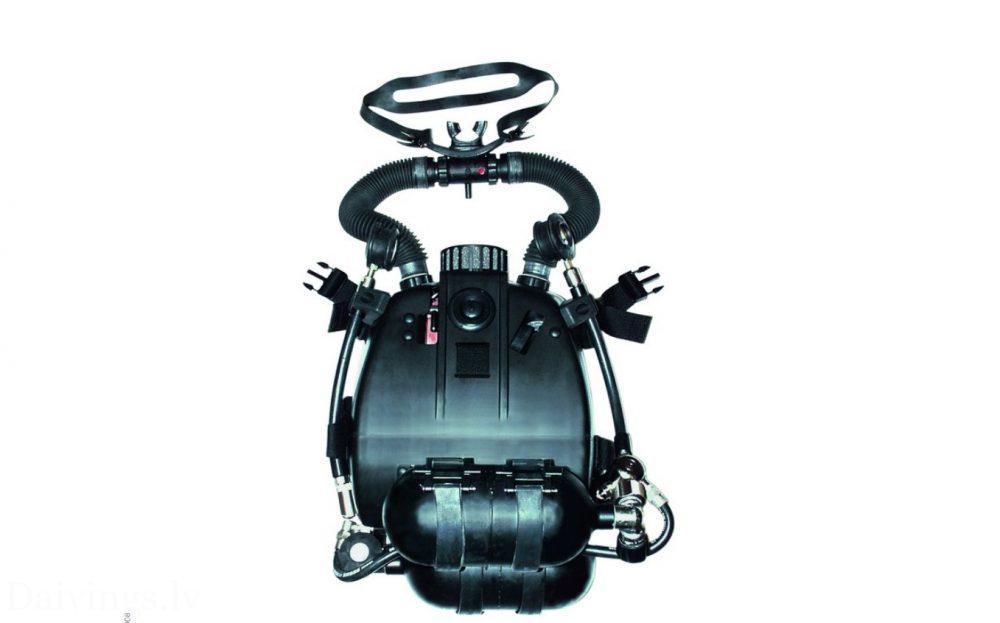
Dräger LAR V and LAR VII, tactical precision
The Dräger LAR series is designed for special task forces (combat swimmers). Their main characteristics are: compactness, low magnetic signature and reliability in extreme conditions.
Dräger LAR V
It is a pure oxygen closed-cycle apparatus (O2 CCR) designed for shallow operations (typically down to 6-10 meters).
- Operating principle: A mechanical oxygen supply valve (lung-demand valve) that responds to the diver's inhalation.
- Advantages: No electronics (can't go wrong), complete absence of bubbles, minimal weight and size.
- Usage: Infiltration, mine neutralization in shallow waters.
Dräger LAR VII (Combi)
An evolutionary leap that combines oxygen CCR and semi-closed cycle (SCR) with Nitrox.
- Hybrid system: The diver can switch between pure O2 for shallow dives and Nitrox for greater depths (up to 24m or 54m depending on configuration).
- Pneumatic control: The machine still maintains a high level of mechanical safety without relying on complex sensors and computers.
- Low acoustic noise: Specifically designed to remain undetected by underwater sonar systems.
JJ-CCR Technical Diving Standard
If Dräger is meant for “invisible access”, then JJ-CCR is designed for “deep research.” It is an eCCR (electronic CCR) in which the partial pressure of oxygen ($PpO_2$) is controlled by a computer.
Technical parameters:
- Depth: Certified to 100m+, limited only by breathing gas (Trimix) composition.
- Control: Two independent computers (typically a Shearwater platform) and 3 galvanic oxygen sensors.
- Construction: Aluminum body (“barrel”) that houses the cylinders and canister, making it one of the most durable devices on the market.
Technical comparison Dräger vs. JJ-CCR
| Function | Dräger LAR VII | JJ-CCR |
| Type | Mechanical O2 CCR/SCR | Electronic (eCCR) |
| Gas control | Manual/Pneumatic | Automatic (Solenoid + Computer) |
| Maximum depth | ~24m (tactical limit) | 100m+ |
| Scrubber (CO2) volume | ~2.3 kg (axial) | ~2.5 kg (axial/radial) |
| Weight (ready for operation) | ~13 kg | ~34 kg |
| Location | Chest (front-mounted) | Back-mounted |
Advantages and disadvantages
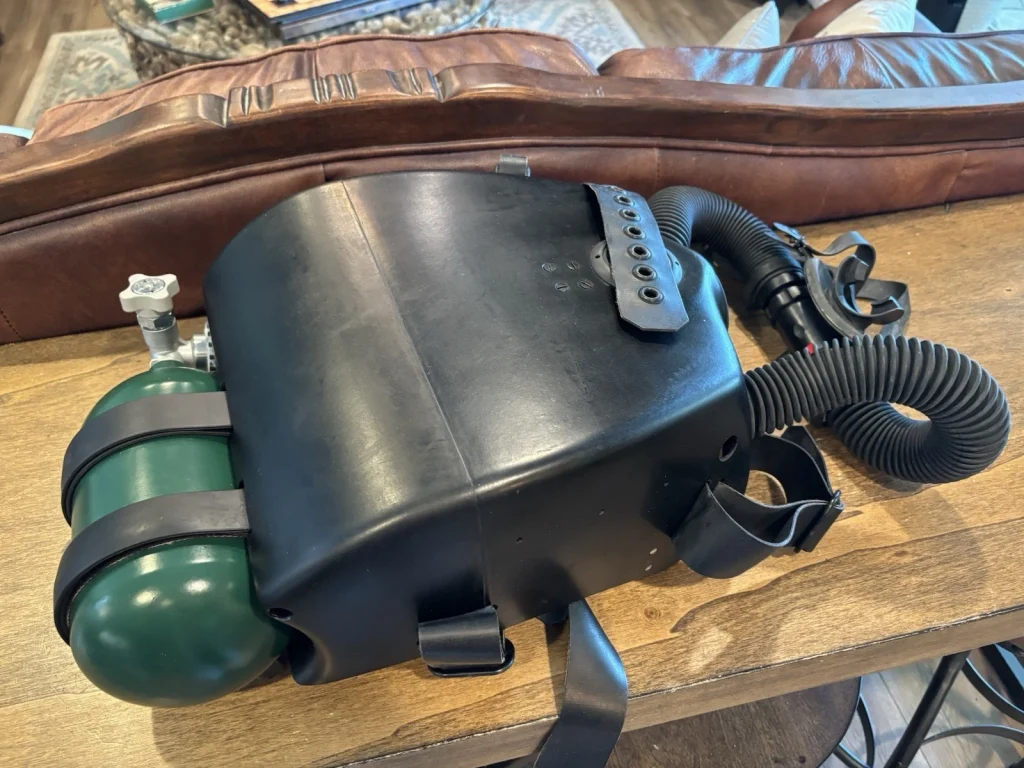
Why choose the Dräger LAR series?
- Weight and mobility: The frontal position makes it easy to use backpacks or jump out of a plane/boat.
- Simplicity: Fewer potential points of failure. No batteries to run out or sensors to float.
- Low profile: Ideal for tight spaces and jobs requiring maximum hydrodynamics.
Why choose JJ-CCR?
- Depth range: Thanks to the use of helium mixtures and precise control of $PpO_2$, it is indispensable for cave and wreck diving.
- Decompression efficiency: The computer maintains optimal $PpO_2$ throughout the dive, maximizing the release of nitrogen/helium from the tissues.
- Modularity: Possibility to attach cylinders of various sizes and additional equipment directly to the frame of the device.
Conclusion
The choice between these systems depends on missionsIf the goal is to move seamlessly in shallow water with minimal weight, Dräger LAR V/VII is unbeatable. On the other hand, if you need to perform complex decompression dives at great depths, where precise control of the gas mixture is required, JJ-CCR is the industry standard.
Note: Dräger series apparatuses (especially magnetically neutral ones) are often only available to military structures and require specific training that differs drastically from civilian CCR methodology.

Training for work with Dräger LAR series devices
It is significantly different from civilian CCR (recreational/technical) diving. It is not focused on enjoying the underwater world, but on tactical task execution, safety and absolute knowledge of the equipment under stressful conditions.
This training is usually divided into three main stages: theory, work "in the dry" and practical lessons in the water.
Theoretical preparation
Before a diver touches the apparatus, he must understand the physiology involved in breathing pure oxygen:
- Oxygen toxicity ($CNS$): Since LAR V uses 100% $O_2$, the main risk is oxygen-induced cramps. Divers learn the limits of $PpO_2$ (usually the limit is 1.3 – 1.4 bar, which means a maximum depth of around 6 meters).
- Risk of hypoxia: “The Silent Killer.” Learn how improper loop purging can lead to oxygen concentrations dropping below critical levels.
- Soda lime ($CO_2$ absorbent) physics: Operating time depending on water temperature and physical activity.
Equipment preparation and checks
In a military environment, mistakes are not allowed, so Pre-dive check is an iron ritual:
- Filling the canister: Proper filling of the absorbent to avoid “channeling” (when exhaled gas finds its way through the gaps without being purified from $CO_2$).
- Vacuum and pressure tests: Check the system for leaks. This is critical because any leaks can allow water to enter the soda lime, creating a “caustic cocktail.”
- Lung Demand Valve Testing: Ensuring that gas delivery occurs automatically upon inhalation.
Practical skills in water (Drill phase)
Training begins in the pool and continues in open water, often at night or in conditions of limited visibility.
Purging procedure
This is the most important skill. The diver must purge the air (nitrogen) from his lungs and the breathing loop, replacing it with pure oxygen. Improper purging is the most common cause of unconsciousness in shallow water.
Tactical Swimming and Buoyancy
Because the LAR is a chest positioning device, the center of gravity changes.
- Trim (position): The diver learns to swim horizontally without creating surface ripples or bubbles.
- Bubble discipline: Learn to control exhalation through the nose (which is prohibited) so that no bubbles burst under the edge of the mask.
Emergency response
- Water inlet into the loop: Procedures for removing water through the exhalation valve.
- Transition to open cycle (Bailout): If the system becomes unbreathable, switch to a backup cylinder (usually a small, separate cylinder).
- Snorkeling: In tactical diving, losing a mask should not interrupt the mission.
LAR VII Specifics: Switching
If the training takes place on LAR VII, a section on operating modes:
- O2 mode: Infiltration in shallow water.
- Nitrox mode: Deeper phase (using a proportioning valve). The diver must be able to switch the gas supply with his eyes closed and understand which mode the apparatus is in by the position of the mechanical levers.
Certification
Unlike PADI or IANTD courses, military training ends with operational qualificationsThis means that the diver has not simply “learned to dive”, but is able to perform a task (such as minelaying or reconnaissance) while fully controlling the LAR apparatus.


