
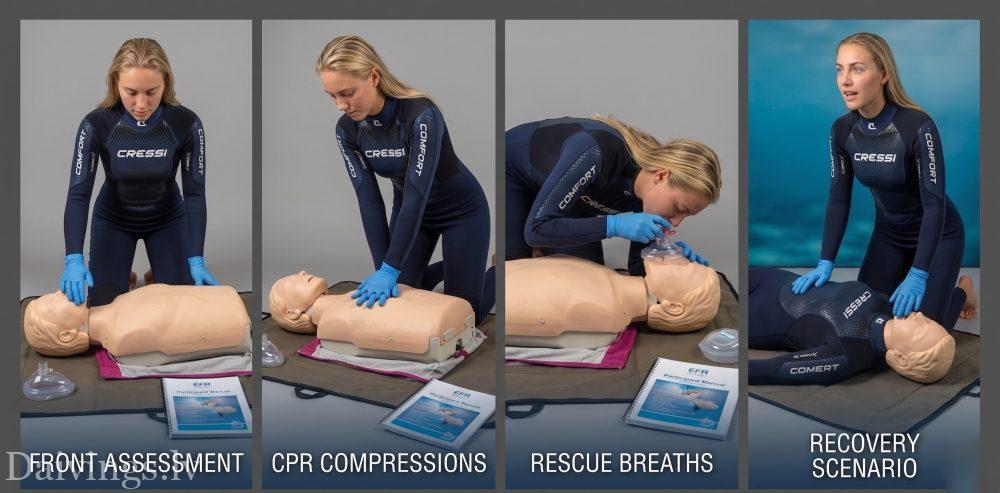
What awaits you in the EFR first aid course?
Plans to learn Rescue Diver (Lifeguard) certification or just want to feel safe in crisis situations both on water and on land? Emergency First Response (EFR) is the first and most important step. It is an internationally recognized first aid course that provides knowledge and, most importantly, practical skills in saving lives.
To dispel any confusion about how the training is conducted, let's take a look at the official EFR student survey. These points perfectly show what standards a quality course should meet and what you will actually do in the lessons.
The course is based on real practice, theory and safety.
A quality course doesn't just consist of an instructor's narration. EFR training is visual and structured:
- Teaching materials: You will be provided with an EFR participant handbook (Participant Manual) that will help you prepare.
- Visual materials: During the course, you will watch the official EFR video, which shows step-by-step the correct action schemes.
- Safety first: During the practical classes, you will learn how to use protective gloves and other barrier equipment. A rescuer must take care of his own safety first!
- Knowledge test: At the end of the course, you will take a final exam to make sure that the theory is clear.
Real practice, not just theory in a book
EFR is not a lecture, it is an active process. Here are the key skills that you will hone to perfection in practice:
Working with a mannequin (Resuscitation)
At least one mannequin must be available at the course location. You will practice personally cardiopulmonary resuscitation (CPR) on the mannequin, feeling the correct depth and pace of compressions.
Practical exercises on a person (Group work)
Many things can't be learned on a plastic doll, so together with your classmates you will practice:
- Initial assessment (Primary Assessment): How to understand what happened to the victim in seconds.
- Preventing critical situations: Stopping severe bleeding, dealing with shock, and stabilizing spinal injuries.
- Injury and illness assessment: How to recognize and assess physical injuries (Injury Assessment) or sudden illness (Illness Assessment).
- Bandaging and immobilization: Dressing wounds and applying splints in cases of dislocations or fractures.
Scenario play (Role playing)
The sweet treat of the course and at the same time the biggest challenge is situation scenarios. Fellow students will play the role of victims, accidents will be simulated, and you will have to make the right decisions and provide assistance in real time, under stressful conditions. This helps to overcome the psychological barrier before providing assistance in real life.
💡 Important after the course: Upon completion of your training, you will receive an official EFR certification card. Make sure the instructor name on it matches the person who actually led your lessons! PADI and EFR organizations strictly monitor these standards.
The EFR course gives you confidence. After completing it, you will no longer be a bystander, but a person who knows how to act and save a life.
Ready to take the next step towards safer diving? Apply EFR for course Daivings.lv today!


