
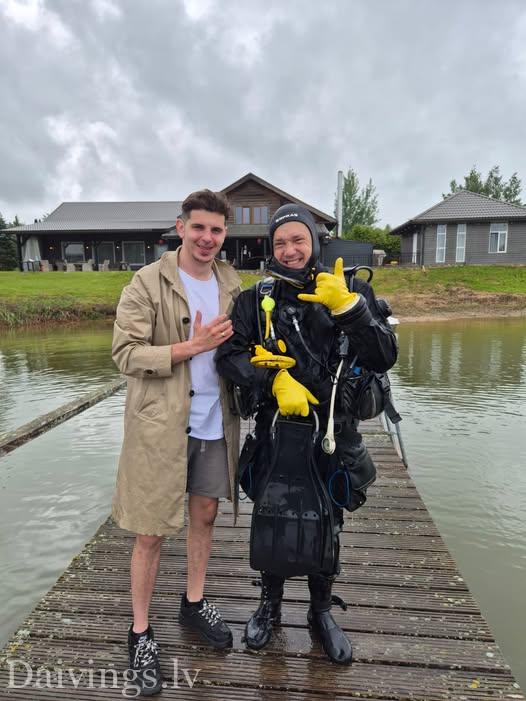
Lost ring? How an underwater diver search operation works
Summer, sun, fun by the water… and suddenly – a click. A ring that has been adorning a finger unnoticed for years slips imperceptibly into the cool water and disappears into the depths. Panic? Understandable, but premature. As long as the treasure is in the water, there is hope of finding it.
The curtain closes in darkness, and the game enters daivings.lv professionals, armed with patience and specialized equipment. How exactly does the search for a ring underwater happen when visibility is close to zero?
Determining the crawl space
The search doesn't start with jumping into the water. It starts on shore with careful planning. The more precisely the client can pinpoint the location where they last saw or felt the ring, the better their chances.
- Marking the area: Divers use buoys and guide lines (cords) to divide the bed into sectors. The search area is strictly limited so that not a single square meter is missed.
- Wind and current factor: Even a small current or waves can affect when and how a piece of jewelry sinks.
Entering the dark and “blind” navigation
In Latvian waters – lakes, rivers and even the sea – visibility often does not exceed a few tens of centimetres. As soon as a diver reaches the bottom, he finds himself in complete darkness or in a cloud of turbidity caused by even the slightest movement.
In such conditions, powerful lights are often powerless, as they only illuminate particles floating in the water, creating a “milky wall” effect. The main vision at this moment is hearing and touch.
Handheld metal detector – diver's eyes
To find a small gold or platinum ring in the mud, ordinary visual searches don't work. Special, water-pressure-resistant tools come to the rescue. hand-held metal detectors (also called pinpointers).
- Scanning millimeter by millimeter: The diver slowly moves along the marked line, holding the detector just above the surface of the bed or lightly dipping it into the mud.
- Signal recognition: When the detector detects a precious metal, it starts emitting an intense sound signal and vibration, which is perfectly felt even through the thick gloves of a wetsuit.
Hand-searching – jeweler's precision
Once the metal detector has given a clear and stable signal, the most complex and meticulous work begins – hand search.
- Preparation: The diver stabilizes himself so as not to stir up the mud further with his fins.
- Filtering through fingers: Based solely on the location of the detector signal, the diver literally sifts, shakes, and filters every handful of mud, sand, and shells with his hands.
- Touch versus sight: Since you can't see anything, your fingers must be extremely sensitive to distinguish the smooth, cold metal of the ring from the rocks and branches.
Is it worth trying for yourself?
Often people try to search on their own, wading with conventional detectors or a diving mask. As a result, the ring is often trampled even deeper into the mud or washed away further. If the thing is expensive (both financially and emotionally), the best decision is to immediately fix the location (for example, by objects on the shore or GPS) and call in professionals for help.
We are ready to help! daivings.lv The team has both experience working in zero visibility and professional equipment capable of finding a needle in even the deepest pile of mud.
Lost something valuable? Contact us and we'll go looking for it!


