
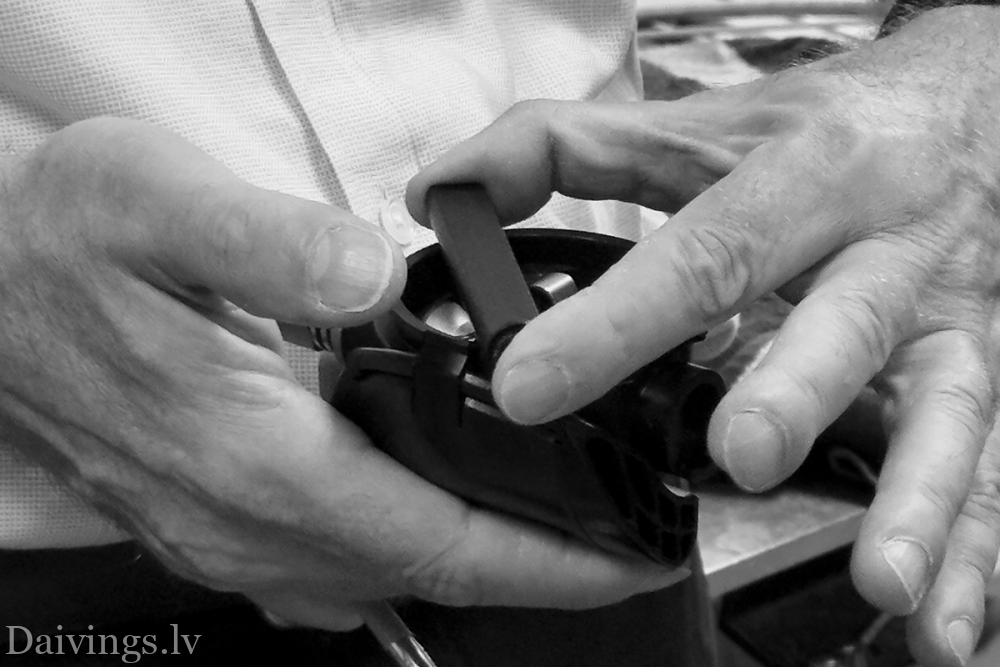
Time to look “under the hood”
Imagine the situation: you are 30 meters deep, there is peace and quiet around you, the visibility is excellent, and you are enjoying the dive. Suddenly, it becomes harder to breathe – it seems that you have to forcefully draw in air. Or vice versa – the regulator starts to “free-flow” uncontrollably, filling the mask with bubbles and rapidly emptying the cylinder.
Your regulator is your life support system underwater. We change the oil in our car every certain number of kilometers, but why do so many divers forget that their diving regulator needs regular and professional maintenance?
During the natural process of use, the parameters of the regulator change. In this article, we will look at what happens inside your regulator, why IP (internal pressure) and Cracking point are critical indicators, and we will show you horror stories from our @Daivings service practice.
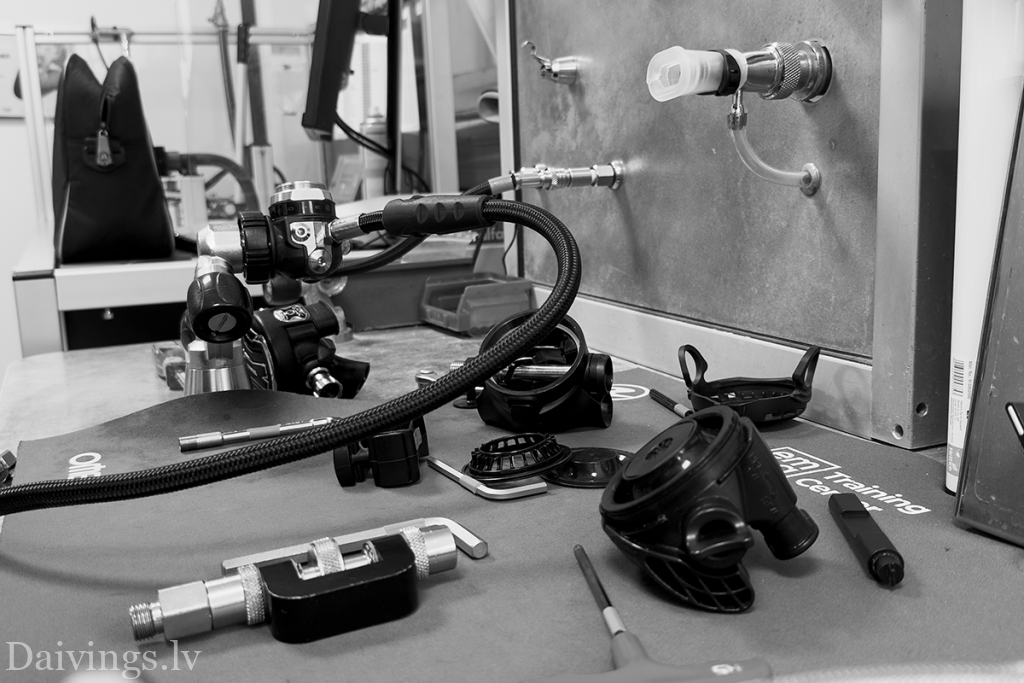
Why is regulator maintenance mandatory? Technical justification
The regulator reduces the high pressure from the cylinder (typically 200-300 bar) to a pressure suitable for breathing. This process occurs in two stages:
- First stage (1st stage): Reduces the cylinder pressure to intermediate pressure or IP (Internal Pressure / Intermediate Pressure), which is typically about $9.5-10.5 \text{ bar}$ above ambient pressure.
- Second stage: Reduces the IP to ambient pressure in response to your inhalation.
During normal use – even if you only dive a few times a year – the regulator’s internal springs lose their elasticity, while the o-rings and seals (seats) wear out and deform. As a result IP may change (increase or decrease), which directly affects breathing comfort and safety.
- If the IP is too high: The second stage will begin to “free-flow”.
- If the IP is too low: Inhalation will become difficult, creating increased resistance and fatigue (which at depth can lead to hyperventilation and panic).
How professional maintenance is done at @Daivings service
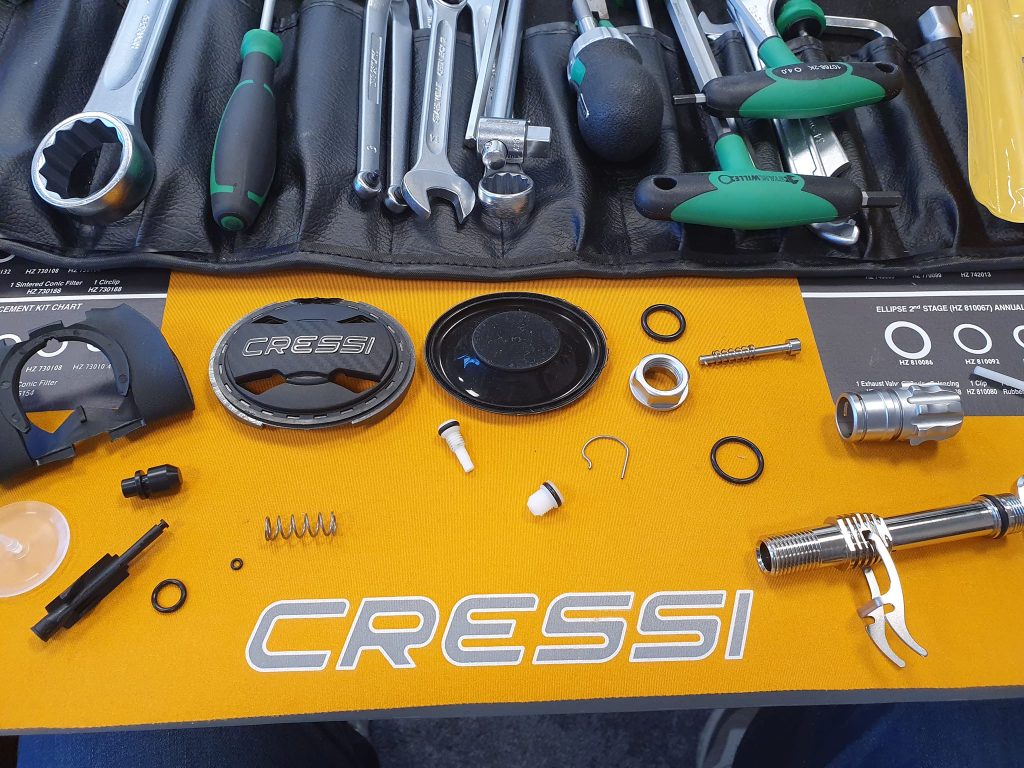
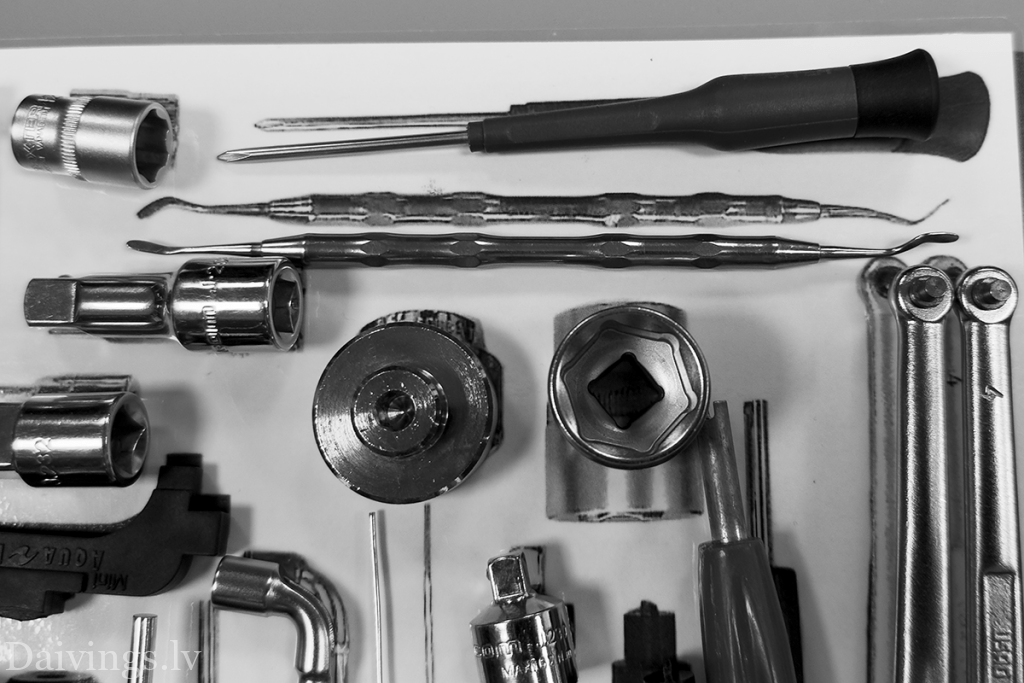
Regulator maintenance is not simply “diluted with water.” It is a high-precision process in which we use specialized tools, torque wrenches, and dynamometers.
Step 1: Initial diagnostics and testing
Before disassembling, we connect the regulator to the diagnostic bench. We check the current IP and its stability (whether the pressure does not “jump”), and also measure Cracking point – the force (in millimeters of water column) required to open the second stage valve and start air supply.
Step 2: Complete disassembly
The regulator is disassembled down to the last screw. All hoses are removed, filters, valves, membranes and all o-rings are removed.
Step 3: Ultrasonic cleaning and desalination
Baltic Sea salt, freshwater sediments and limescale cover metal parts. All metal parts are placed in a special ultrasonic bath with specific chemical solutions that gently but completely remove corrosion and salt crystals without damaging the chrome plating.
Step 4: Defecting and replacing parts
All old o-rings, high pressure seals (HP seats), second stage valve seals and conical filters are discarded. They are replaced by original manufacturer's (Apeks, Scubapro, Dive Rite, etc.) service kits.
Step 5: Assembly and lubrication
Assembly is carried out using the manufacturer's specified torque and only oxygen-compatible lubricants (e.g. Christo-Lube). This is critical to ensure the regulator is ready to work with enriched air (Nitrox).
Step 6: Precision calibration and dynamic tests
This is the most important stage. Using Magnehelic measuring devices and specialized manometers, we set:
- Precise IP (first-degree action).
- Perfect Cracking point (second-stage breathing ease) so that the regulator provides maximum air flow with minimal inspiratory effort, but at the same time does not flow on its own.
“Horror stories” from our service, some of the worst examples that could have been prevented
Our service technicians see regulators teetering on the brink of disaster every week. Here are three of the most glaring examples that homeowners could have prevented with timely maintenance:
The “Green Monster” or complete corrosion inside the first stage
- What we saw: The first stage environmental chamber was full of a green, calcified mass that completely blocked the mainspring. The customer complained that he was “starting to run out of air at depth.”
- Why did it happen: After diving in the sea, the regulator was not rinsed with fresh water, or during rinsing, water entered the first stage inlet (where the filter is located) because the dust cap was not installed.
- Consequences: Permanently damaged housing and spring. Timely maintenance and proper flushing would have prevented this for 100%.
Broken and “swollen” HP filter
- What we saw: The conical inlet filter was black from compressor oil residue and so deformed from the pressure that air pushed through it with enormous resistance.
- Why did it happen: The regulator had not seen service for several years and was filled from compressors of questionable quality.
- Consequences: At any moment, the filter could have completely collapsed, trapping metal shavings directly in the first-stage valve, which would have caused an immediate loss of air supply at depth.
“Sprouted potatoes” in the second stage mouthpiece
- What we saw: An entire ecosystem had formed under the membrane in the second-stage housing – sand, dried algae, and mold right near the mouthpiece.
- Why did it happen: The regulator was not properly rinsed after the dive and was stored in a damp, closed bag in a warm room.
- Consequences: In addition to the diver literally breathing in mold spores, the grains of sand damaged the valve seal, causing constant “micro-freeflow.”
Conclusion: Check “Internal Pressure” and “Cracking point” on time!
The start of the diving season, preparing for a trip, or simply a year since the last service – these are all reasons to take care of your safety. Don't wait for the regulator to announce problems while you're underwater.
@Daivings service provides accurate first and second level testing with professional tools. We will not only replace worn parts, but also precisely calibrate your regulator so that you can breathe as easily and comfortably underwater as you do on land.
📞 Schedule your regulator maintenance at @Daivings service, tel. 220-77-202 today and dive safely again!


