
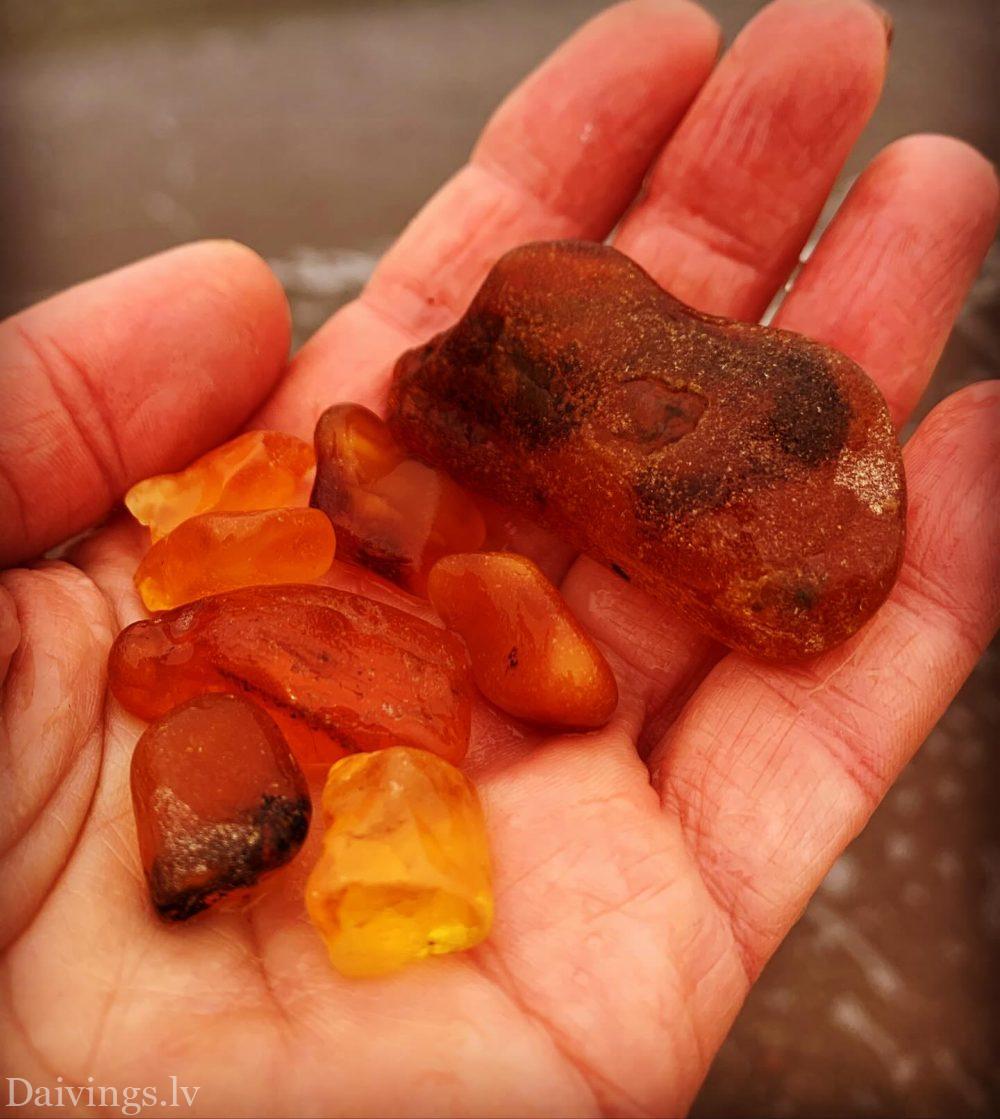
Healthy walks along the sea can sometimes bring pleasant surprises, especially for souvenir seekers. The Baltic Sea is generous in its amber, or “sunstones,” and while it may be a challenge for divers to find amber in Baltic waters due to its light weight, knowledge about this gemstone and where it can be found can be useful for any coastal visitor.
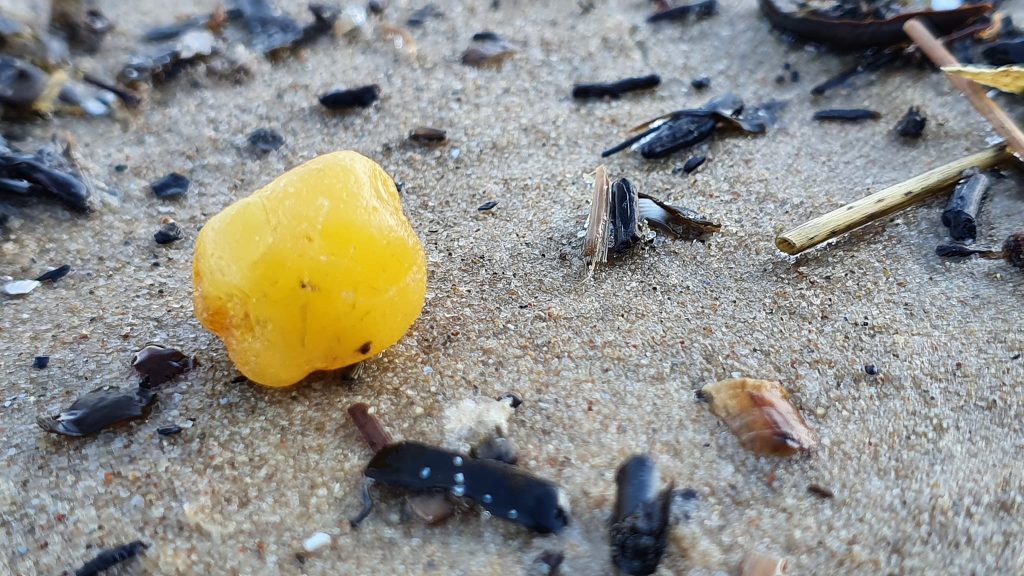
What exactly is amber?
Amber is a fossilized resin that formed from ancient conifers more than 50 million years ago. It is the only gemstone that originated from the plant kingdom. Its value is determined not only by its beauty, but also by its antiquity. Although classically amber is a warm honey hue, it can also be black, whitish and even, rarely, bluish. Historically, amber has also been called sea wax, sunstone and tiger's soul.
When and where to look for amber?
The greatest chance of finding amber is after large storms from the S (south) or SW (southwest) directionThen the sea throws them ashore.
- Kurzeme coast is especially generous to amber seekers. Pavilosta and Liepaja are the most popular places that boast large quantities of amber. Also Jurmalciems and the beach strip between Bernātis and Liepaja are known as good places to find amber (and unfortunately also phosphorus).
- Even On the coast of the Gulf of Riga Amber can be found! For example, diving club instructor Valters Preimanis found a piece of amber almost the size of a Euro coin on the beach of Jurmala on February 12, 2022, after several major storms. Major storms wash away not only parts of ancient ships, but also these sun stones.
- Search in places where there are lots of seaweedbecause amber is often washed ashore with them.
- Also search for places where there are a lot of stones, because amber is often found between them.
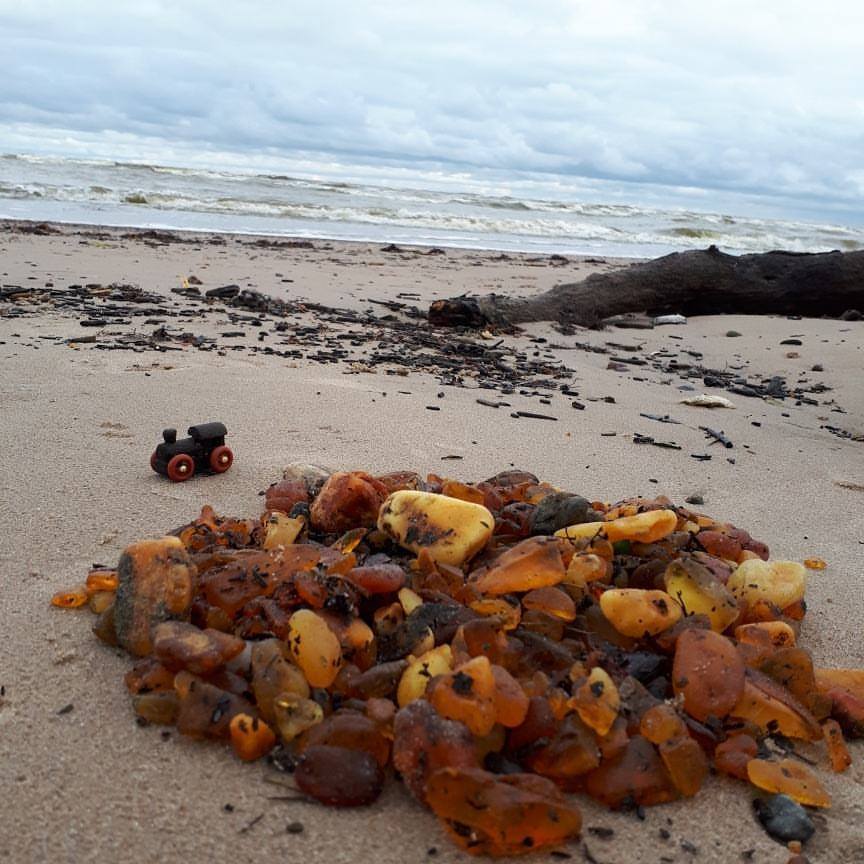
Practical tips for amber seekers:
- The best way to find amber early in the morning or late at nightwhen there are fewer people on the beach.
- Be patient! Finding amber can take time and effort.
- Wear comfortable shoesbecause you will have to walk on sand and stones.
- Don't forget about hat and sunscreen, especially in summer.
- Take it with you water and snacksbecause searching can be tiring.
- Leave the beach clean! Place all waste in the designated containers.
How to recognize real amber?
Distinguishing real amber from other stones or dangerous white phosphorus is very important.
- Touch: Real amber is warm and pleasant to the touch.
- Appearance: It has a transparent or yellowish color. When broken, it is transparent, with a bright, pronounced color. Amber is hard and smooth. Most often, they are small stones.
- Smell: If amber is rubbed, for example, against trousers, it should smell like resin.
- Saltwater test: If you are unsure, drop the find into salt water (about 8-10 teaspoons of salt per glass of water). Real amber will float, but other stones and many imitations will.
- UV light: The authenticity of amber can be determined with an ultraviolet lamp (the kind used to test money). Real amber will have a blue-green hue under this lamp.
Warning: White phosphorus – a dangerous counterpart!
A walk by the sea can end in unpleasant surprises if instead of amber you end up with white phosphorus. It is a legacy of the Soviet army that the sea washes ashore from time to time, especially often found in the section between Bernāti and Liepāja, as well as in Jūrmalciems.
How to distinguish amber from phosphorus?
| Sign | Amber | White Phosphorus |
| Color | Yellow, clear, bright, strong color | Greenish, grayish-yellowish, matte, duller shade |
| Structure | Hard, smooth, broken transparent | More crumbly, brittle, with a jagged surface, not transparent when broken |
| Smell | Odorless (rubbed – resinous) | There may be an unpleasant, garlic-like (very faint) odor |
| Size | Most often small stones | There may also be suspiciously large pieces |
| Other signs | Phosphorus pieces do not have sharp edges (according to one source), are not as clear |
Security check: If in doubt, DO NOT put the find in your pocket! You can test it in a primitive way – by heating it in wet sand with a lighter flame. Phosphorus, heated and dried, will ignite!
Amber in history
Our ancestors not only noticed the nuanced beauty and ease of processing of this stone (it is quite soft), but also were aware of its magical properties. They believed that amber increases strength and cheerfulness of spirit, attracts luck, strengthens health, thwarts the plans of ill-wishers and protects from the evil eye. Amber brooches were already mentioned in Homer’s “Odyssey”, it adorned the headdress of the Egyptian pharaoh Tutankhamun. During the reign of the Roman emperor Nero, merchants were sent to the northern lands specifically for Baltic amber, because it was considered the most valuable in the world. In ancient times, a piece of such a sun stone could be exchanged for a powerful slave. The Baltics, rich in forests, are still an amber land on the shores of the Amber Sea.
Searching for amber on the Baltic Sea coast is a great way to spend a day. It is an exciting and rewarding activity that can be enjoyed both alone and with the family. Good luck with your “sunstone” hunt!


