
Boeing B-17 Flying Fortress Search
The Baltic Sea, with a history of navigation, trade and brutal conflict, is today considered one of the world's richest repositories of underwater archaeology. Its unique hydraulic conditions, including low salinity, cold water and lack of oxygen in the deeper layers, provide an excellent conservation environment for both wooden shipwrecks and more modern metal structures. A special place in this underwater museum is occupied by the aviation heritage of World War II, which bears witness to the air war that raged over northern Europe in the 1940s. In the summer of 2025 and early 2026, the scientific community and military history enthusiasts were shocked by the news of a significant discovery in the Gulf of Kiel, near the coast of Denmark: after more than eight decades, the legendary US bomber has been located and identified Boeing B-17 Flying Fortress.
This discovery is not just a technical achievement in maritime archaeology; it has a profound humanitarian and historical dimension. The project was led by Texas A&M A team of researchers from Texas A&M University, led by Dr. Piotr Bojakowski, in close collaboration with US Department of Defenses Missing Persons Agency (MPAA). The mission's primary goal was to provide answers about the fate of the missing crew members, thereby closing one of the thousands of unsolved cases still held in military archives. Estimates show that the whereabouts of approximately 81,000 American soldiers from past conflicts are still unknown, and each such operation is a step closer to honoring their memory and bringing peace to their loved ones.
The strategic role of the B-17 Flying Fortress
To understand the value of the scrap found at the bottom of the Baltic Sea, it is necessary to take a detailed look at the aircraft itself – Boeing B-17 Flying FortressThis four-engine heavy bomber became a symbol of the US Air Force's prowess and strategic approach to air warfare, based on precision bombing during the day. The aircraft was developed in the mid-1930s, and its prototype Model 299 first flew in 1935. Even then, it impressed with its speed and firepower, which was significantly greater than that of the twin-engine bombers of the time.
The B-17's development over the years was a direct response to the challenges of the battlefield. While early models (B, C, and D) suffered from structural deficiencies and inadequate fighter protection, later modifications transformed the aircraft into a true "fortress." The B-17E introduced a significantly enlarged tail section and a rear gun turret, which improved stability and protection from the rear. The B-17F and eventually the B-17G models received even more powerful Wright R-1820 Cyclone engines and additional armament, including a chin turret to repel frontal attacks, which had become a favorite tactic of German Luftwaffe pilots.
The aircraft's physical dimensions and technical parameters were impressive in 1943. Its wingspan reached 31.6 meters and its length was 22.6 meters. Its maximum take-off weight exceeded 29 tons, and it was capable of delivering several tons of bombs to targets located thousands of kilometers from the base.6 However, these technical specifications could not completely protect crew members from the brutality of aerial combat. On average, a B-17 crew in 1943 had only a 251% to 331% chance of surviving the 25-mission cycle required to return home.
In total, the United States produced 12,731 Flying Fortresses, and they dropped more than 640,000 tons of bombs on targets in Nazi Germany and its occupied territories, which amounted to approximately 42.6% of the total Allied bombs dropped on Europe.
Air war over the Baltic region in 1943
- The year was a crucial time in the Allied bombing campaign. The US Eighth Air Force launched massive raids deep into Germany, targeting strategically important factories, shipyards, and transportation hubs. The Baltic Sea served as both a landmark and a danger zone where aircraft could land after sustaining damage or running out of fuel.
Air combat tactics at the time were based on close formations, known as the “Combat Box.” This system was designed to maximize the firepower of the B-17’s machine guns by creating overlapping defense zones. However, maintaining the formation was physically and mentally exhausting for the pilots, and any aircraft that fell behind the group due to damage became an easy target for German fighters. Raids on cities such as Wilhelmshaven, Bremen, and later Schweinfurt took huge casualties. For example, the raid on Schweinfurt and Regensburg on August 17, 1943, resulted in the loss of 60 aircraft, representing approximately 161 TP8Ts of the force involved—a loss rate that was unsustainable in the long term.
The B-17 that sank in Kiel Bay was likely part of such an operation. The intensity of the fighting in 1943 meant that the skies over Denmark and northern Germany were filled with smoke, anti-aircraft fire, and burning aircraft. Many crews, realizing they would not be able to reach their bases in England, attempted to make emergency landings at sea or in neutral countries such as Sweden.
Expedition 2025
The work of the Texas A&M University research team in Kiel Bay is a classic example of modern marine archaeology, combining historical research with cutting-edge technology. The mission began with a precise location of the site based on a 2001 report. It should be noted that the Baltic Seabed is often covered with a thick layer of sediment, which can completely hide even objects as large as a four-engine bomber.
Remote sensing phase
The first step was to map an area of one square kilometer using two main technologies:
- Side-scan sonar: This device emits sound waves that bounce off objects on the seabed, creating a high-resolution acoustic image. Sonar is able to identify anomalies that differ in shape from the natural terrain, such as straight lines or the metallic sheen characteristic of aircraft wings or engines.
- Magnetometric scanning: The aircraft contains a significant amount of ferromagnetic materials (steel in the engines, weapons, and landing gear). The magnetometer measures local changes in the magnetic field, allowing archaeologists to “see” through sand and mud where aircraft parts may be buried.
After the anomalies were recorded, targets were placed for further inspection. A remotely operated underwater vehicle (ROV) equipped with video cameras and lighting was used. It was the images captured by the ROV, which showed the airfoil of the aircraft, that gave the team confidence that they had found the object they were looking for.
Diving operations and visual documentation
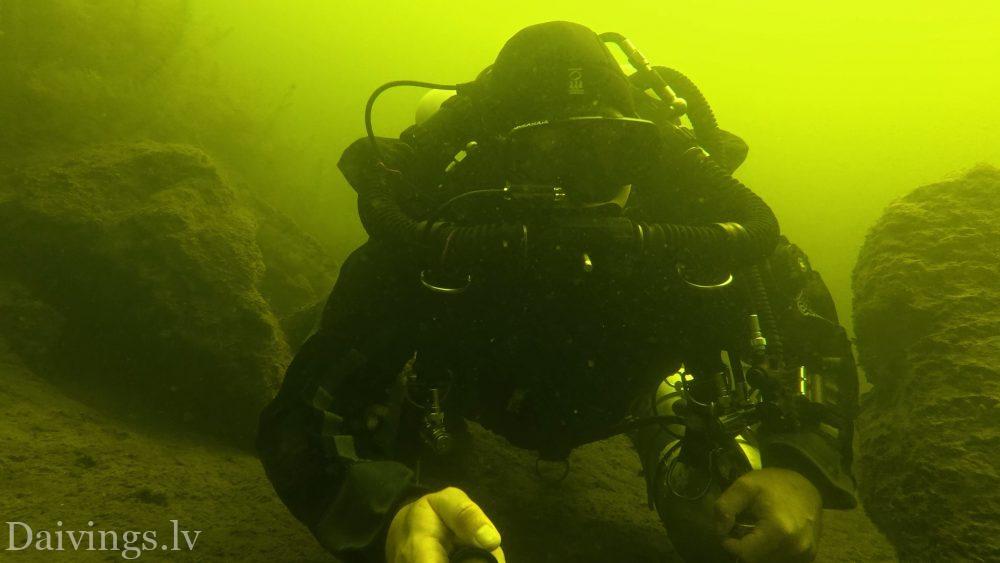
Once the ROV had confirmed the location of the wreck, divers stepped in. The Baltic Sea conditions in the Gulf of Kiel are particularly difficult: visibility is often less than 3 meters, and the turbidity of the water causes disorientation.2 Divers had to swim in close contact with the bed, using GoPRO cameras and diving boards to record every visible object and its coordinates.
Diver Bethany Becktell described the site not as a whole plane, but as a “debris scatter.” This is typical of aircraft crashes in water, where the force of the impact literally tears the fuselage into fragments. However, among the wreckage, the main components were clearly identifiable: the engines, the cockpit window frame, the tire and the fuel tank. One of the most striking finds was the three-bladed propeller, which still retains its shape and has become one of the most easily recognizable parts of the aircraft.
The decisive evidence was the serial numbers of the machine guns
In naval archaeology and military history, aircraft identification often relies on small but specific artifacts. In the case of the B-17, the “smoking gun” was two .50-caliber Browning machine guns. They were knocked out of position by impact and lay in the sand for decades, remaining in surprisingly good condition.
As anthropology professor Katie Kuster Boyakowska explained, machine guns were strictly numbered military units during World War II. Each weapon had a unique serial number, and military archives documented exactly which machine gun (by serial number) was installed on a particular aircraft (by its factory and tail number). After the machine guns were raised to the surface and cleaned of marine sediment, the serial numbers became legible.
This discovery allowed researchers to conduct further archival research to:
- Positively identify the specific aircraft.
- I would like to find out the names of the crew members who were on board the fateful mission.
- Provide information to the DPAA so they can contact the descendants of the soldiers.3
The table below illustrates typical B-17 serial number ranges, which helped researchers narrow down the aircraft model and production batch.
Such a detailed database of serial numbers is critical because it allows archaeologists to understand whether they are looking at an aircraft that disappeared in early 1943 (which would likely be an F model) or a later modification. The Kiel Bay find, dating to 1943, most often indicates a B-17F or early B-17G model.
Natural conditions of the Baltic Sea
One of the main reasons why machine guns that have spent 80 years underwater are still useful for identification is the specificity of the Baltic Sea. This sea is considered a marginal part of the ocean with a unique hydrological regime.
Salt level and temperature
The Baltic Sea is brackish water, meaning that its salt concentration is significantly lower than in the oceans. This factor is crucial in slowing down metal corrosion. In addition, the cold water temperature slows down the chemical reactions that usually destroy duralumin and steel structures.
Biological factors
Unlike warm seas, the Baltic Sea has historically not been inhabited by woodworms. Teredo navalis (although in recent years it has begun to appear in the southern part due to climate change). This means that wooden elements, if they have been in the aircraft interior or accessories, can survive for centuries. For metal aircraft, the main conservation threats are electrolytic corrosion between different metals and anaerobic bacteria, which can cause the accumulation of sulfur compounds.
Legal framework and protection of underwater heritage in the Baltics
The issue of diving at historical wrecks and the recovery of artifacts is strictly regulated both internationally and nationally. The countries of the Baltic Sea region, including Latvia, Estonia and Lithuania, have developed joint guidelines for the protection of underwater cultural heritage.
International conventions
The 2001 UNESCO Convention on the Protection of the Underwater Cultural Heritage is the main document that stipulates that underwater heritage must be preserved. in situ (on site) as the first choice. Although World War II aircraft are still on the threshold of 100 years (after which they automatically become protected heritage), many countries classify them as important historical monuments already now.20
The Latvian National Cultural Heritage Board (NKMP) and the authorities of other Baltic states emphasize that any unauthorized removal of artifacts is not only illegal, but also ethically unacceptable, as it interferes with the identification process of missing soldiers.
Comparison with other B-17 wrecks: Adriatic Sea vs. Baltic Sea
To better understand the uniqueness of the Kiel Bay find, it is useful to compare it to other known B-17 wrecks around the world. One of the most famous examples is located off the island of Vis in Croatia, in the Adriatic Sea.
The B-17G (serial number 44-6630) in the Adriatic Sea sank in November 1944 after being damaged by anti-aircraft fire over Slovenia.10 Unlike the Baltic Sea B-17, this aircraft made a controlled landing on the water and sank almost intact. It lies at a depth of 70-72 meters and has become an icon among technical divers.
This comparison shows how much crash conditions (impact on water vs. controlled landing) and environmental factors affect what researchers find 80 years later. The Baltic Sea is somewhat more lenient on small artifacts (such as machine gun mechanisms) thanks to the sediments that encapsulate them, while the Adriatic Sea preserves the aesthetic appearance of the aircraft.
DPAA activities and results for 2025
The role of the U.S. Department of Defense’s Missing Persons Agency (MPAA) in such missions is critical. In fiscal year 2025, the agency reported a historic achievement, identifying 231 soldiers, the highest number since 2019. Of these identifications:
- 165 were from World War II.
- 58 from the Korean War.
- 8 from the Vietnam War.
This success is based not only on archaeological findings, but also on scientific advances in DNA analysis. The DPAA uses a method called Single Nucleotide Polymorphism (SNP) or single nucleotide polymorphism analysis, which allows for the determination of kinship even from highly degraded bone fragments by comparing them with distant relatives. The Baltic Sea B-17 Project is part of this global effort, and it is expected that, once the data is fully processed, specific names will be announced for the airmen who were previously considered “lost at sea.”
Conclusions
The discovery of the Boeing B-17 Flying Fortress in the Baltic Sea is a stark reminder that history is still alive and well, and that even after 80 years, through perseverance, international cooperation, and modern science, it is possible to find answers to the most complex questions.
Such finds place a great responsibility on the diving community. Each wreck is a fragile ecosystem and a piece of history. As Dr. Piotr Boyakovskis pointed out, the goal is not just archaeological research; the goal is to understand what happened and bring peace to the families. The Baltic Sea will continue to reveal its secrets, but it is our duty to ensure that these stories are told with respect and scientific accuracy.
In the coming years, as remote sensing technologies and underwater photogrammetry develop, we can expect even more such discoveries. The waters of Latvia, home to countless sunken ships and aircraft from both world wars, are still waiting for their researchers. Cooperation between professional archaeologists, state institutions and a responsible diving community is the key to preserving and exploring this heritage. The return of the B-17 Flying Fortress from the depths is not just a story of metal; it is a story of courage, sacrifice and an eternal commitment not to forget those who did not return home.


