
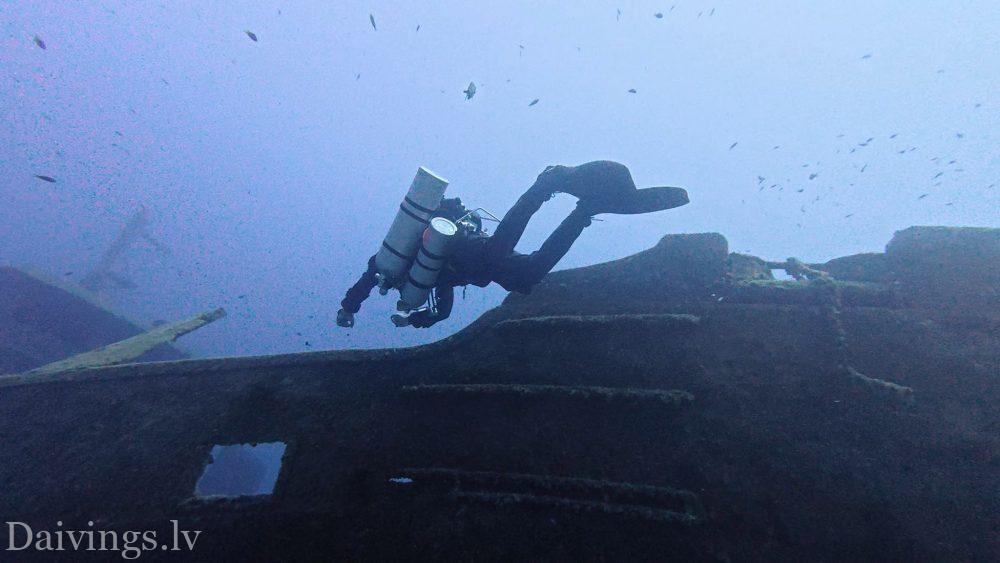
JJ-CCR (Closed-Circuit Rebreather) is an advanced technical diving tool that, by maintaining an optimal partial pressure of oxygen PO2, significantly extends dive time and improves decompression efficiency. However, these benefits require understanding and tight control over the silent but potentially lethal enemy – oxygen toxicity. CCR divers often maintain high PO2 (typically $1.2-1.4 \text{ ATA}$), so toxicity risk management is more critical than in open system diving.
I. Central Nervous System (CNS) Oxygen Toxicity
CNS toxicity, also known as Paul Beer effect (Paul Bert Effect), is acute a neurological response caused by too high a PO2. It usually occurs suddenly and is the main limitation on maximum depth and PO2 levels.
Symptoms (VENTID-C mnemonic): They start with mild disturbances: Vision, Ears (e.g. ringing), Nausea, Muscle twitching (Twitching, especially of the lips and face), Irritability, Dizziness and end with seizure (Convulsion). A seizure underwater is usually fatal.
CNS Table and Clock
To manage this risk, it is used CNS Clock or CNS (percentage of oxygen exposure). It measures cumulative oxygen exposure by comparing the time spent at a given PO2 level with the maximum allowable time for that pressure (e.g., in NOAA tables).
- Management Limit: The conservatively recommended maximum CNS is 80% per dive and 100% in a 24-hour period.
- Time Limits (examples):
- $1.6 \text{ ATA} \rightarrow 45 \text{ minutes}$ (maximum allowed $\text{PO}_2$ rebreather emergency).
- $1.4 \text{ ATA} \rightarrow 150 \text{ minutes}$ (commonly used deco setpoint).
- $1.3 \text{ ATA} \rightarrow 180 \text{ minutes}$.
JJ-CCR Context: In a CCR system, $\text{PO}_2$ is constantly maintained at a high level, so the diver must accurately monitor the time and calculate $\text{CNS \%}$ at each setpoint.
II. Pulmonary Oxygen Toxicity
Pulmonary toxicity, or The Lauren Smith effect (Lorrain Smith Effect), is chronic a problem that occurs when exposed to elevated $\text{PO}_2$ environments for long periods of time. This is a major limitation for very long and repetitive dives.
Symptoms: It affects the respiratory system, causing damage to lung tissue. Symptoms include: dry, irritating cough, pain in the chest area (substernal pain) and shortness of breath.
OTU (Oxygen Toxicity Units):
The risk of pulmonary toxicity is measured by Oxygen Toxicity Units (OTU).
- Definition: One OTU is obtained by breathing $\mathbf{100\%}$ oxygen ($1.0 \text{ ATA} \text{ PO}_2$) one minute.
- Cumulative Impact: OTU is calculated using factors that adjust the time at a given $\text{PO}_2$ according to the baseline $1.0 \text{ ATA}$.
- Daily Limit: Usually recommended conservative limit is $\mathbf{300 \text{ OTU}}$ in 24 hours (especially important on long, repeated diving expeditions).
III. Recent Research and Controlling Factors
Research involving prolonged technical diving (typical of JJ-CCR use) continues to optimize toxicity management.
- $\text{PO}_2$ Extended Limits: Newer guidelines (especially for $1.3 \text{ ATA}$) allow longer exposures in some cases than those specified in the old 24h tables (e.g. up to $240 \text{ min}$ in the working phase and an additional $240 \text{ min}$ in the decompression phase). However, this issue is still under discussion.
- $\text{CO}_2$ As a Major Co-factor: The most significant recent discovery for CCR divers is that increase in carbon dioxide ($\text{CO}_2$) levels in breathing gas dramatically lowers the threshold For the onset of CNS toxicity.
- Practical Importance of JJ-CCR: A poorly functioning soda lime (scrubber), excessive ventilation, or cold can cause a buildup of $\text{CO}_2$. In this case, a seizure can occur even at a “safe” level of $\text{PO}_2$. This highlights scrubber maintenance and calm breathing techniques importance.
Summary:
When diving with JJ-CCR, toxicity management is two-fold: rigorous monitoring CNS % with the help of PO2 sensors to avoid acute neurological danger, and should be followed OTU level in the long term to protect your lungs. Always remember that CO2 control is as important as O2 control.


