
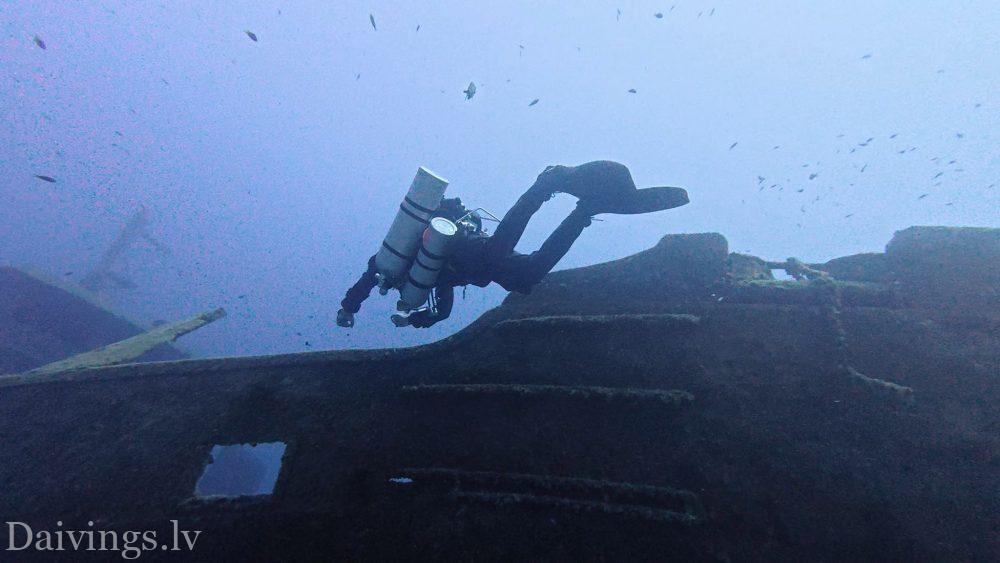
PADI Technical Instructor Valters Preimanis shares what you need to know about nitrox diving before you start your diving course Enriched Air Diver course.
🐠 Introduction: Oxygen-enriched air conquers the underwater world
Nowadays, on diving motor yachts you can see that there are Nitrox's characteristic green-yellow tanks, which signals that someone is diving with Enriched Air Nitrox – abbreviated EANx or simply called “enriched air” or "nitrox"It has been used in recreational diving for decades, and every major training agency has a program for enriched air diving.
When used correctly, Nitrox is an effective tool, which increases your no-decompression time (NDL) for longer dives and/or shorter surface intervals, all other things being equal and the gas supply permitting. However, it is potentially dangerous if not used properly. Nitrox has shallower depth limitations and other problems that do not have to be considered when diving with regular air for recreational diving.
As a PADI Enriched Air Instructor Trainer, I've learned a thing or two about nitrox – so let's dive into it.
1. What is nitrox and how is it different from air?
Recreational diving enriched nitrox air is any mixture of nitrogen/oxygen gases with additional oxygen. The air you breathe when scuba diving is approximately 21% oxygen and 79% nitrogenIn contrast, a nitrox mixture will have a higher proportion of oxygen – for recreational diving, this is usually 32% or 36%That's why you'll often hear these mixtures referred to as "Nitrox 32" or "Nitrox 36".
You may also encounter the terms EANx36 or EAN36 – this means a gas mixture consisting of 36% oxygen and 64% nitrogen.
2. How is diving with nitrox different from diving with air?
The goal of EANx is not supplemental oxygen, but less nitrogenBy reducing the amount of nitrogen you inhale, you can extend your bottom time without increasing the theoretical risk of decompression sickness (DCS).
The deeper (higher pressure) and longer you dive, the more nitrogen dissolves in your tissues. If you surface with too much dissolved nitrogen, bubbles can form, causing DCS. Staying within the no-decompression limits limits the theoretical amount of dissolved nitrogen so that you can ascend directly to the surface (making a safety stop) with a low risk of DCS.
- Example in deep diving: Imagine you are diving to a depth of 30 meters. On regular air, according to the Recreational Dive Planner (RDP), your no-decompression limit (NDL) is 20 minutes. But when diving with EANx32, your NDL at the same depth is 30 minutes.
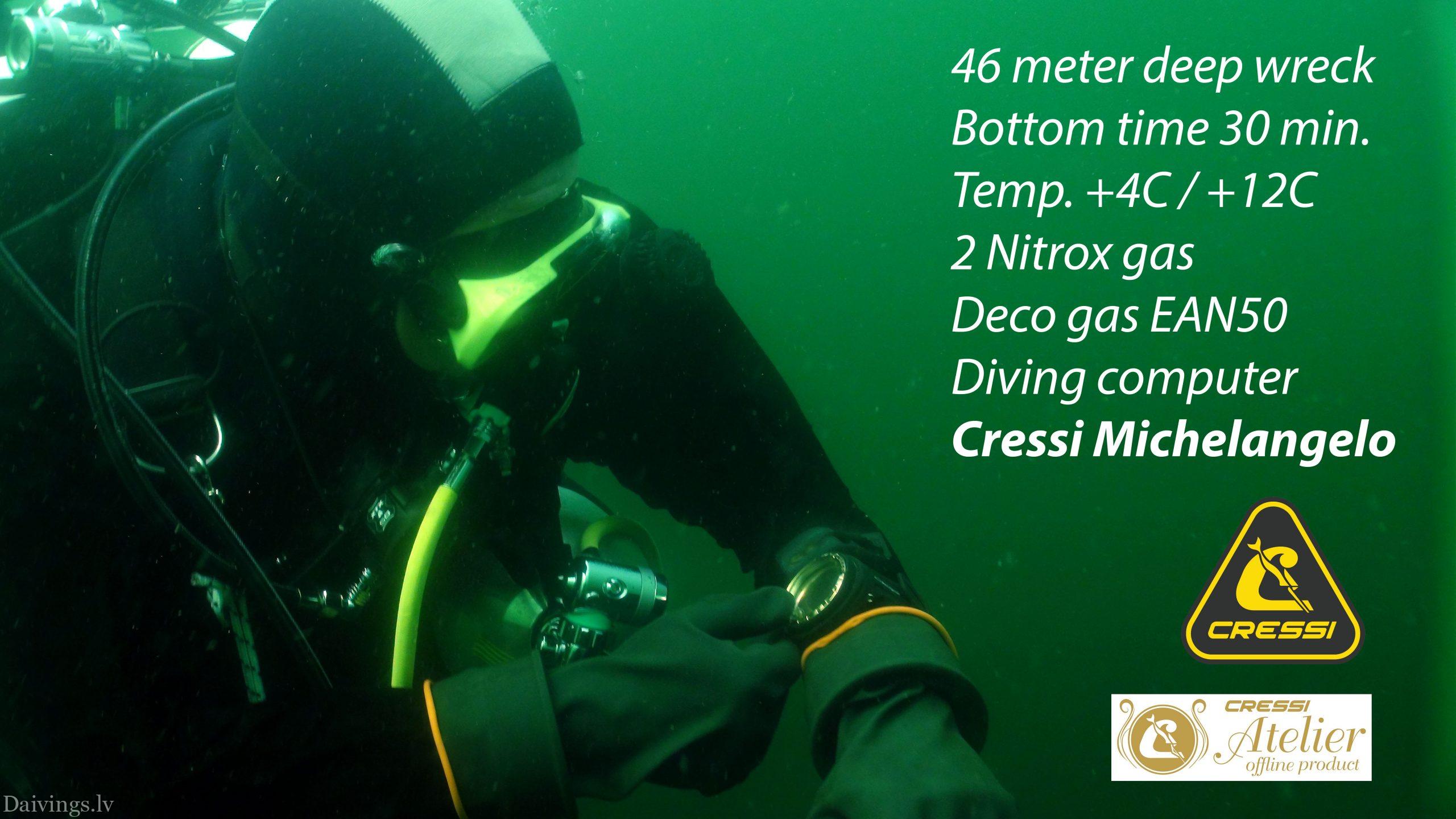
- Equivalent Air Depth (EAD): When using nitrox with air tables, you calculate an EAD, which tells you how much nitrogen you are taking in. For example, when diving 21 meters deep with EANx36, your EAD is 15 meters because you are taking in nitrogen as if you were 6 meters shallower with air.
- Computer use: Nowadays, dive computers are most commonly used that calculate the benefits. In most cases, with EANx, dives, even repetitive ones, are limited by your gas supply, not your no-decompression time.
3. Nitrox diving certification
Get your PADI Enriched Air Diver certification It's not difficult, but it's important. You will learn:
- eLearning training course: Learn about EANx theory, equipment considerations, and risk management.
- Practical classes for the course: By training with a PADI professional, you gain practical experience, analyzing the EANx mixture (to know exactly what mix you are using) by setting your dive computer for that mix and filling out an enriched air logbook.
Nitrox is one of the most popular continuing education skills in diving.
4. Advantages and disadvantages of Nitrox diving
✅ Advantages:
- Longer primer time: The main advantage is a longer no-decompression time.
- Optimized depth: The most beneficial use of nitrox is at depths between 15 and 30 meters. At shallower depths with air, the NDL is already long enough.
- Greater conservatism: Even when diving for longer periods, you can still be conservative and reduce the practical risk of DCS by staying “well inside” the limits.
❌ Disadvantages:
- Oxygen toxicity: Breathing oxygen at elevated partial pressures for extended periods of time can become dangerous and cause oxygen toxicity. Symptoms include seizures, blurred vision, nausea, twitching, or dizziness.
- Shallow Maximum Depth (MOD): To prevent the risk of toxicity, the PADI Enriched Air Diver course teaches you how to determine the maximum depth (MOD) for each EANx mix. This is why nitrox mixes have shallower depth limits than regular air for recreational diving.
5. EANx cylinder marking and analysis
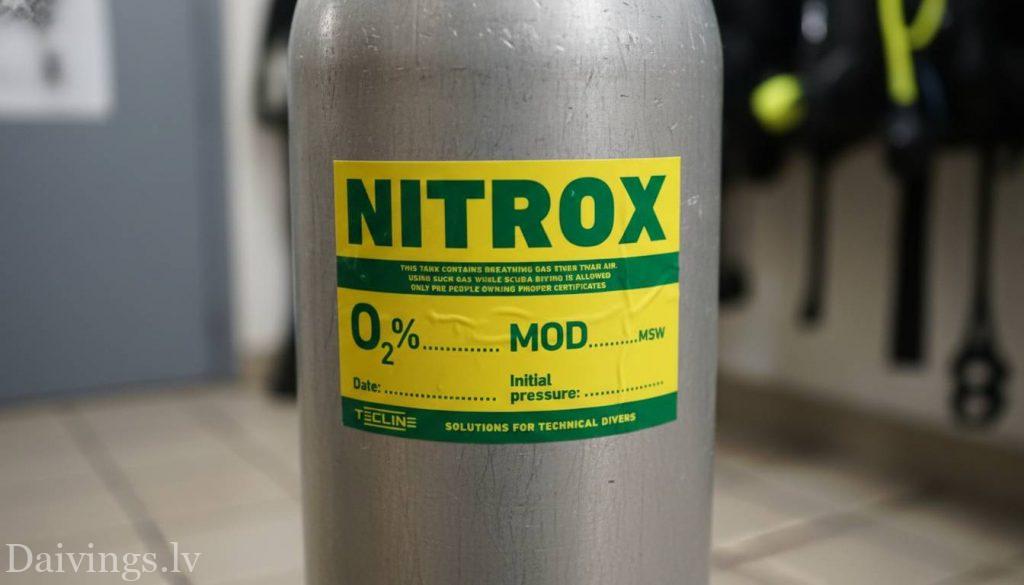
To reduce risk, EANx cylinders are clearly marked to prevent confusion with standard air:
- Labeling: Nitrox tanks are marked with yellow and green ribbon at the top of the tank.
- Information sign: The label or tag states: oxygen content (percentage), maximum depthuntil which this mixture may be used, and diver's name.
- Analysis: The diver must personally analyze the gas (using an oxygen analyzer) and a log must be signed, indicating the EANx percentage and the maximum depth of use.
6. Myths about nitrox
Nitrox is sometimes considered a panacea, but there are some myths:
- Myth 1: Nitrox reduces nitrogen narcosis.
- Reality: At the depth (30-40 meters) where the risk of narcosis begins, you should stop using nitrox because of oxygen toxicity. Moreover, oxygen is just as narcotic as nitrogen. Dr. Peter Bennett writes that the preventive value of nitrox is “very small, so marginal that, in my opinion, it should be discounted.”
- Myth 2: Nitrox reduces gas consumption.
- Reality: It doesn't work that way because most of the oxygen you inhale is exhaled unused. The next breath is determined by the need to exhale carbon dioxide, and is not affected by the contents of the tank.
- Myth 3: Nitrox reduces fatigue.
- Reality: While many nitrox divers swear this is true, a blinded study of labeled and unlabeled cylinders found no difference. Bennett calls this the “placebo effect.”
- Myth 4: You can dive deeper with nitrox.
- Reality: On the contrary, EANx sets a shallower depth limit. However, the myth may stem from the fact that technical divers use EANx, but not during the deep part of the dive – they use it during decompression stops when ascending from a deep dive.
7. Choosing the right nitrox mix and equipment
Standard mixes and customization:
- Common mixtures: Most dive shops offer 32% or 36% mixtures.
- Custom blends: You can use other mixtures that may be “best suited” for a particular dive. Dive shops can often mix a mixture with any percentage below the recreational diving limit – 40% oxygenFor example, for a dive to a depth of 21 meters, the EANx40 will provide a significantly longer NDL than the EANx32.
Equipment safety:
- Up to 40% oxygen: According to generally accepted practices, standard scuba equipment can be used for oxygen concentration up to 40%.
- Cylinder cleanliness: One exception is scuba tank – it must be specially marked and often intended for use with pure oxygenThis is because the creation of nitrox mixtures (especially customized ones) requires the tank to be filled with pure oxygen first, followed by filtered, oxygen-compatible air. Therefore, the tank must meet oxygen operating standards (O-rings, valve seats, and lubricants must be suitable for pure oxygen) and must be cleaned annually.
🌊 Summary of Nitrox diving
Nitrox diving has become an essential skill for many recreational divers due to its ability to extend bottom time and increase conservatism by reducing nitrogen uptake. While EANx offers significant benefits at depths of 15 to 30 meters, divers must understand and manage the risks associated with it, especially the shallower maximum depth due to oxygen toxicity. By earning the PADI Enriched Air Diver certification, you gain the knowledge and skills to safely analyze the mix, set up your computer, and get the most out of nitrox.
Do you want to start your nitrox diving adventure? Write to us today!


