

The evolution of diving instruments has gone through three major phases: the analog era of mechanical pressure gauges, the digital era of handheld computers, and the modern era of integrated “Heads-Up Display” (HUD) systems. This transition is not just a change in display; it is a fundamental reconfiguration of the diver’s cognitive load and situational awareness. Projection systems that display critical data (depth, gas pressure, and decompression status) directly in the diver’s field of vision eliminate the need to constantly look away from the environment, thereby improving safety.
This article analyzes the evolution of HUD technology in five parts, covering history, optical physics, mechanical engineering, wireless protocols, and future perspectives on augmented reality (AR).
Historical genesis and transition from military to commercial sector
The development of the underwater HUD was driven by the need for hands-free operation for combat divers and special operations forces. In tasks involving underwater navigation, mine clearance or rescue operations, the diver cannot afford to manually check instruments.
The CDDM Project and Oceanic Legacy
The first significant step was a joint project between the company Oceanic Worldwide and the US Navy's Coastal Systems Station (CSS) in Florida. This collaboration resulted in the Combat Diver Display Mask (CDDM), which served as the basis for the first commercial HUD model: Oceanic DataMask.

- released at the beginning of the year DataMask integrated a liquid crystal display (LCD) panel directly into the lower right quadrant of the mask lens. As can be seen in the documentation for modern systems, this design used a proprietary optics package to magnify the data, creating the illusion that the information was “floating” into the distance.
| Year | Event | Technology | Impact on the industry |
| 1972 | Oceanic founded (Bob Hollis) | Analog instrumentation | The basis for the production of diving equipment in the USA. |
| End of 1990 | CDDM Project (US Navy/Oceanic) | LCD projection | Demonstrated the viability of HUD in combat conditions. |
| 2008 | Oceanic DataMask Launch | Integrated LCD HUD | The first commercial “hands-free” computer. |
| 2016 | NSWC PCD DAVD prototype | Transparent AR HUD | Introduced “Ironman” style sonar overlay. |
| 2019 | Scubapro Galileo HUD release | Micro-OLED mask mount | Popularized modular, foldable architecture. |
Optical engineering and physics of underwater vision
The biggest challenge in HUD design is the human eye's inability to focus on objects that are only a few centimeters away. In a terrestrial environment, the eye's closest focal point is about 20 cm. Without corrective optics, any image placed near the mask lens (5–10 cm away) would be an illegible blur.
Refractive index crisis
Underwater, the problem is compounded by the loss of refractive power between air and the cornea. The human eye's focusing power depends on the transition between air ($n \approx 1.0$) and the cornea ($n \approx 1.376$). When immersed in water ($n \approx 1.33$), this power is neutralized, causing a loss of about 42 diopters.
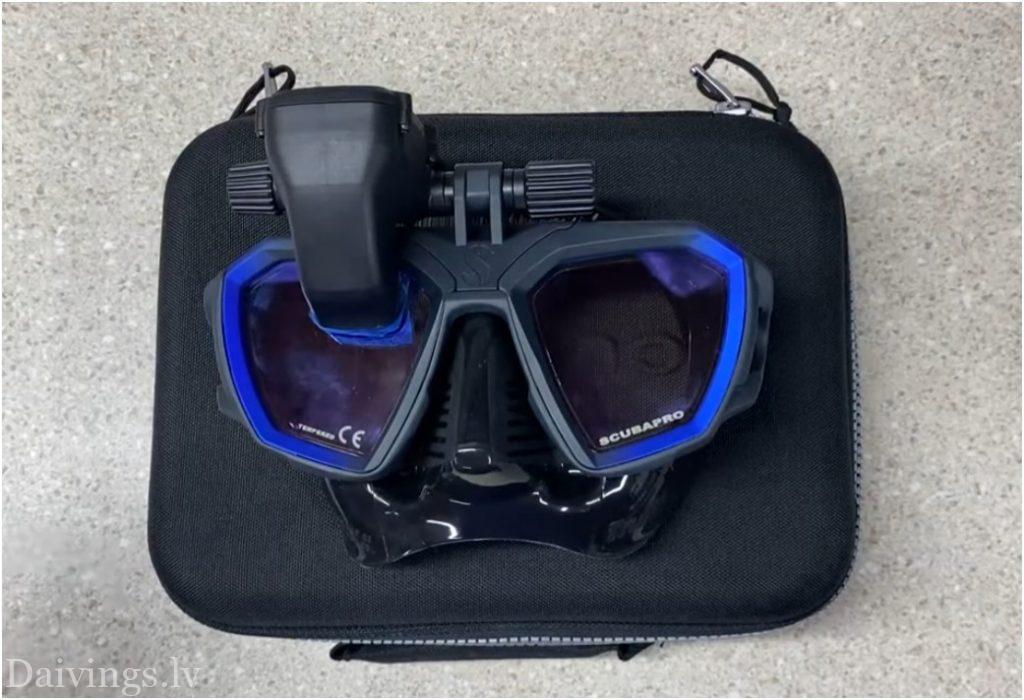
To solve this, systems such as Scubapro Galileo HUD (shown in Figure 1) and Shearwater NERD 2 uses a “dry” optical path. The microdisplay is sealed in a hermetic housing with an air pocket. Collimating lenses transform the display rays into parallel beams, creating a virtual image. Scubapro In this case, the image appears at a distance of approximately 1 meter. , in turn Shearwater NERD 2 uses a magnifying lens to create the effect of a 25-inch TV screen at a distance of 3 meters.
Display Technology: OLED vs. LCD
Modern units have moved to Micro-OLED technology due to its self-emitting nature. OLED provides excellent contrast and power efficiency (black pixels consume no power), which is critical for diving at night or in murky water. Galileo HUD (Figure 4) OLED brightness is prioritized to ensure readability even in strong sunlight on the surface.
Hardware architecture and mechanical integration
There are two main approaches to HUD integration: a mask-mounted modular system and a controller/loop-mounted technical system.
Mask attachment systems (Scubapro model)
Scubapro Galileo HUD is a modular device that attaches to the bridge of the mask (see Figure 1). Its main advantage is a hinge mechanism that allows the display to be folded up when not needed, for example, when taking macro photography or swimming on the surface. The user interface is controlled by a single rotating dial, which is easy to operate even with thick neoprene gloves.
Technical systems (Shearwater model)
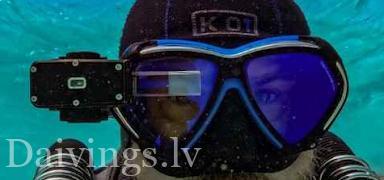
Shearwater NERD 2 (Near Eye Remote Display) attaches to the second stage regulator hose or rebreather loop (Figure 3). This architecture is popular with technical divers because it is independent of mask choice. If the mask floods or is lost, the diver does not lose access to data while the regulator is in the mouth. The body of this device is more durable and designed for depths of up to 300 meters.

| Mechanical aspect | Mask attachment | Regulator mount |
| Platform | Diving mask (center) | Reg. hose / CCR loop |
| Mobility | Folding up | Fixed or movable on the hose |
| Depth rating | 120m (recreational/technical) | 300m (extreme technical) |
Wireless data transmission and air integration
The HUD's usefulness is maximized when it displays the air pressure in the balloon. This is achieved through wireless air integration (AI).

Physics of underwater transmission
Traditional signals (Bluetooth, Wi-Fi) operate at a frequency of 2.4 GHz, which is absorbed by water molecules at a distance of a few centimeters. To get around this, the diving industry uses very low frequency (VLF) waves, typically 38 kHz. This frequency is able to travel reliably through salt water for a distance of about 1.5 meters, reaching the mask receiver from the first stage of the cylinder.
Modern transmitters, such as Shearwater Swift, uses collision avoidance protocols:
- Unique ID codes: Each transmitter has a unique serial number to prevent signal mixing between divers on board.
- Channel “listening”: The transmitter checks whether the frequency is free before sending data.
Human factors and augmented reality
The goal of HUD is to reduce “task saturation.” However, a poorly designed user interface (UI) can cause “attention tunneling,” where the diver becomes overly focused on the numbers and fails to notice dangers in the environment.
Biometric integration and the future
Research in 2025 suggests integrating biometric sensors directly into the skirt of the mask. Using photoplethysmography (PPG), the mask can measure heart rate and oxygen saturation ($SpO_2$) through the skin of the forehead. If your heart rate is rising rapidly, the HUD may issue a warning: “Relax and breathe slower” to prevent panic or CO2 buildup.
Future “smart masks” (as seen in conceptual Figure 2) will use artificial intelligence to identify fish species in real time, show navigation paths to shipwrecks, and connect to the cloud for post-dive analysis.
Conclusion
Underwater HUDs have evolved from exotic military prototypes to critical safety tools. By harmonizing optical physics, mechanical strength, and wireless communications, these systems have transformed the diving mask into an intelligent interface, ensuring that the most important information is always in front of your eyes.


