
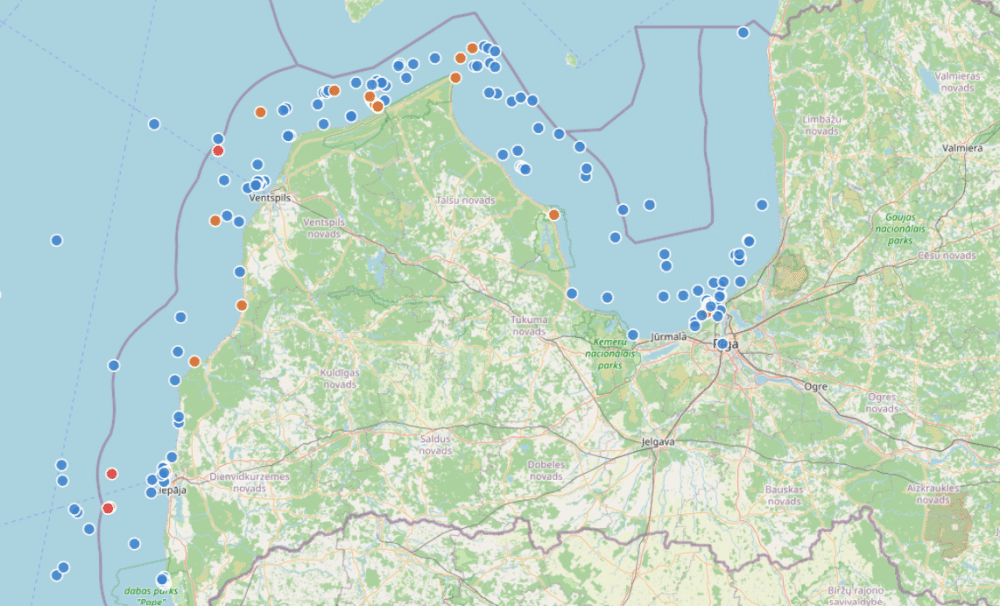
The Baltic Sea and the Gulf of Riga are one of the world's most unique destinations for underwater archaeology and technical diving. Thanks to the low salinity of the water, cool temperatures, and the presence of shipworms (Teredo navalis) due to the lack of, wooden and steel shipwrecks here remain in excellent condition for decades and even centuries.
At the same time, the Baltic Sea demands the highest level of responsibility: variable visibility (from 0.5 to 10+ meters), a strong thermocline (where the temperature at depth drops to 2–4°C even in the middle of summer), currents and historical military threats require precise planning, appropriate equipment and unconditional compliance with legislative requirements.
Requirements for divers and technical equipment
Diving in the open sea and deep on wrecks is significantly different from recreational diving in lakes or warm southern seas.
Qualification levels:
- Basic open sea diving: The minimum recommended level for shallow coastal sites (up to 18–20 m) is Advanced Open Water Diver (AOWD) or equivalent, preferably with Dry Suit Diver specialization.
- Wreck inspection: To safely navigate around wreck structures, you need Wreck Diver certificate. If penetration (entering the wreck) is planned, specialized training is mandatory (Advanced Wreck).
- Technical and decompression diving: A large part of the most important historical sites on the Latvian coast are located at a depth of 30–65+ meters. Such expeditions require Decompression Procedures, Extended Range, Trimix or closed-circuit breathing apparatus (CCR / Rebreather) qualification.
Equipment standards for cold and demanding waters:
- Thermal protection: Dry suit (Drysuit) with appropriate warm underwear and dry gloves is a standard requirement. Hypothermia sets in rapidly at depth and significantly increases the risk of decompression sickness (DCS).
- Independent breathing systems: Mandatory cold water (Cold Water EN250) regulator with a closed dry chamber that protects against freezing and free flow (free-flow). Double balloon set (Twinset with insulator) or Sidemount A configuration with two completely independent regulators is the safety minimum for technical divers.
- Navigation and safety buoys: Each diver should be equipped with a decompression buoy (DSMB) and a reel with at least 50 meters of line, a reliable compass, bright underwater lights (with a backup light) and at least two cutting tools (serrated knives or line cutters / line cutter) to get rid of abandoned fishing nets.
- Surface support: The boat or cutter from which diving takes place must be equipped with an international diving flag. "A" (Alpha), a medical oxygen breathing kit (100% $O_2$), a first aid kit and a functioning marine VHF radio (channel 16).
Legislation and coordination procedures in Latvian waters
The procedure for diving in the territorial waters and exclusive economic zone of the Republic of Latvia is determined by Maritime Administration and Maritime Safety Law, as well as Cabinet of Ministers Regulation No. 133 of 1 March 2016 “Regulations on Diving in the Sea in Restricted Areas”.
The Latvian Maritime Administration (LMA) has registered on the coast and in the Gulf of Riga 170 wrecks, divided into open areas, historical wreck protection zones and special regime areas:
A. Free zones (144 objects)
Objects located outside designated landfills and military zones (e.g., a steamer Arniston, icebreaker Oleg, armored cruiser Prinz Adalbert etc.).
- For these objects no separate diving permit requiredif diving is for sports/recreational purposes and no removal or tampering with wreckage is done.
- Mandatory requirement: Before going out to sea, the ship/boat captain informs about the planned operation, number of divers, location and time. Coast Guard Maritime Search and Rescue Coordination Center (MRCC Riga) via VHF channel 16 or phone +371 67323103.
B. Diving Restricted Areas (IT1 – IT21)
These 21 areas contain 19 wrecks (including the Cape Kolkasrags sailing ship, Henry Lütgens near Jurkalne, Oviši and Irbe Straits ships):
- For persons wishing to dive in these areas, in accordance with Cabinet Regulation No. 133 must obtain permission from the National Cultural Heritage Board (NKMP).
- The aforementioned permit is issued by the NKMP only after coordination with Coast Guard, State Environmental Service (SES) and Latvian Maritime Administration.
- Permits are issued for archaeological, scientific or research purposes.
C. No-diving areas (AT1 – AT6) and explosives areas (NSR)
Areas with special danger (unexploded ordnance from World War I and II, active military training grounds):
- In these areas (for example, near the German cruiser Bremen wreck in the AT6 zone, wreck #103 near Liepāja in the NSR5 zone or wrecks #157/#158 in the NSR6 zone) diving is strictly prohibited.
- In exceptional cases, a permit may be issued only after special coordination between the National Armed Forces and ministries.
D. Protection zones of historical wrecks (VVK1, VVK2)
State-protected cultural monuments (e.g. Daugavgrīva wreck V and Kolka Wreck I) is determined 500 meter protection zone:
- Within this radius, it is strictly prohibited to drop anchor, disturb the bottom, or perform any activities that may damage historical structures.
Consequences of violations: Unauthorized diving in restricted and prohibited areas, as well as the removal of objects and equipment from shipwrecks, is a criminal and administratively punishable act. The wrecks are either national cultural heritage or the graves of deceased sailors.
Step by step: How to organize and coordinate a diving trip at sea
- Choose a destination and check the status:
- Using the LJA navigation warning and chart data, make sure that the selected wreck is not in the AT or IT zone.
- Check the hydrometeorological forecast:
- For safe diving from small vessels in the Baltic Sea, wind speed should not exceed 4–6 m/s, and wave height should be below 0.5–0.8 m. Special attention should be paid to currents near the capes (Kolkasrags, Akmeņrags).
- Team briefing (Briefing) and gas analysis:
- Check the percentage of all divers' breathing gases $O_2$ and helium, calculate the maximum operating depth ($MOD$, at $\text{pp}O_2 \le 1.4\text{ bar}$) and decompression gases ($\text{pp}O_2 \le 1.6\text{ bar}$).
- Align the landing line (shot line) and emergency procedures (loss of partner, current, decompression skip).
- Contacting the Coast Guard:
- Before leaving the port, inform MRCC Riga of the name of the vessel, number of persons on board, dive coordinates and planned return time.
- After diving:
- After all divers have ascended to the deck and safely completed the decompression regime, inform MRCC Riga of the successful completion of the operation when heading to port.
Ecological responsibility and "Ghost networks" (Ghost Nets)
Abandoned and entangled fishing nets are a significant underwater hazard in the Baltic Sea. They not only endanger divers' safety by creating a risk of entanglement on the deck of a wreck, but also continue to kill fish, seals and seabirds for years without control, and as they decompose, pollute the sea with microplastics.
- Tangle prevention: When swimming past wrecks, always keep your distance from loose ropes and netting, maintain a horizontal trim, and avoid unnecessary sudden movements.
- Reporting: If you identify dangerous ghost nets while diving, record their coordinates, depth, and photo documentation to pass on the information to marine conservation societies and responsible services for their organized removal.
The information was prepared for the diving community Daivings.lv in collaboration with experts in the maritime and underwater industry.