

Introduction
The Baltic Sea, known among divers for its well-preserved shipwrecks, hides one of the most enigmatic underwater discoveries of our time: Baltic Sea anomaly (BJA). This object, found at a depth of 90 meters, has become the subject of international scientific interest and speculation. Treasure hunter Denis Oshberg (Dennis Åsberg) and his team stumbled upon this massive structure in 2011, which does not fit into any known geological or man-made category. The purpose of this article is to provide technical insight into the structure of the BJA and the unique phenomena encountered by the underwater exploration team. The Daivings.lv team offers to explore this mysterious object.
Conditions and Physical Parameters
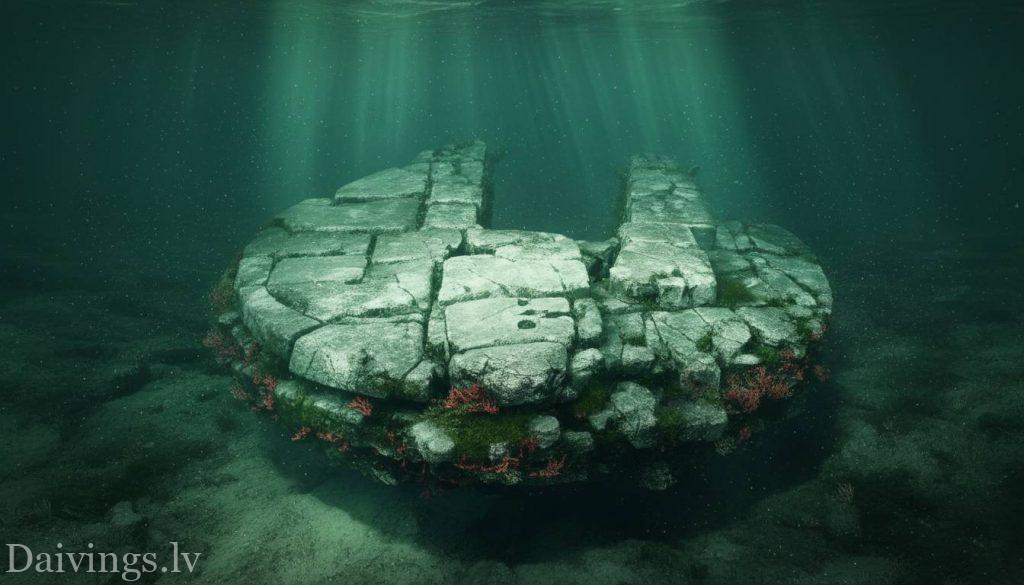
The anomaly is located in the Baltic Sea, approximately 60 kilometers offshore, between Sweden and Finland, at a depth of 90 meters. The object was discovered using side scan sonar (sidescan sonar) while the team was searching for a historic shipwreck. The sonar images revealed a massive, round structure. The BJA is approximately 60 meters, covering more than 3000 square meters seabed surface. The object is a circle with a rough surface. Although the object has earned the name “underwater UFO” among the surface community, professional underwater researchers classify it as Unidentified Underwater Object (UOO).
Morphological Analysis and Structural Features
The morphology of BJA raises strong suspicions of artificial originSonar data and remotely operated vehicle (ROV) video show structures that are rarely found in nature:
- 90 Degree Angles and Corridors: The object has been observed to have clear 90-degree angles and flat walls that form corridor-like structures, indicating engineering involvement.
- Round Hole: A large, circular opening (approximately 2 meters in diameter) with a frame is observed, giving the impression of a structured element.
- Separation from the Foundation: Using profiling of the lower layers (sub-bottom profiling), the data obtained show that BJA is separated from the seabed. This technically rules out the possibility that it is a simple geological formation, such as a rock or a mountain.
Electromagnetic and Environmental Anomalies
The most interesting and technically disturbing are the physical phenomena that occur near the object and indicate a strong electromagnetic (EM) field or energy source:
- Equipment Failures: As the object approaches, all underwater and surface equipment begins to malfunction. GPS signal, radars show phantom objects (phenomena that are not actually there), and ROVs, as well as divers' cameras and lights, stop working. These disturbances are correlated with the proximity of the object, indicating a local, strong EM source.
- Temperature Deformation: One of the divers reported that the water temperature directly above the object was close to 0°C, although the normal temperature at this depth is 4–5°C. This indicates a local thermal anomaly.
- Atmospheric Phenomena: Recorded thunderstorms and lightning strikes directly above the location of the object, which could indicate that the structure is acting as an electrical leader or affects local weather conditions.
Material Composition and Biogeological Footprints
Visual and initial material analysis provide conflicting indications about the nature of the object:
- Surface Inspection: The object has a dark, almost black color. Attempts to take a core sample failed because the material turned out to be extremely hard for conventional underwater instruments.
- Basalt and Organic Footprints: Loose samples taken from the surface of the object contained basalt (volcanic rock, not typical for the Baltic Sea) and biologically incinerated materialThe presence of basalt could indicate a volcanic origin transported by a glacier, or material exposed to very high temperatures. The biological material is unusual because the Baltic Sea at this depth is known as a “dead zone.”
- “Breathing” Opening: Divers have observed that water is leaking from the BJA opening (20 cm in diameter) cloudy, milky water, which periodically moves in and out, giving the impression that the object “breathe” – almost like a biological organism.
Hypotheses and directions for further research
There are currently two main hypotheses for the origin of BJA, both of which are extremely unusual:
- Unidentified Underwater or Flying Object (USO/UFO): The strong electromagnetic and energy-related anomalies, as well as the irregular 90-degree angles, are consistent with reports of unidentified aerial phenomena (UAPs) around the world.
- Ancient, Artificial Structure: Based on its location detached from the seabed and atypical geological features, there is a theory that the object could be an ancient, man-made structure built when the site was on land, possibly before the end of the Younger Dryas period.
It is clear that BJA is not:
- Meteorite/Asteroid: The crater is missing, and the object is standing on the seabed.
- Volcano: The structure does not correspond to the morphology of volcanic formations.
Further research is focused on collecting additional data, including: core drilling at the site to obtain intact material samples for analysis. Radioactivity measurements and detailed profiling of the surrounding sediment layers are also planned.
Conclusion
The Baltic Sea Anomaly remains an unsolved mystery. Its unique geometric features, combined with the observed electromagnetic and thermal disturbances, make it an unusual object on a global scale. For Daivings.lv divers, this story serves as a reminder of how little we know about the depths of the planet and how much potential lies in underwater exploration. Whether the BJA turns out to be a natural wonder or evidence of ancient or even extraterrestrial technology, its study continues to expand the boundaries of our knowledge.


