
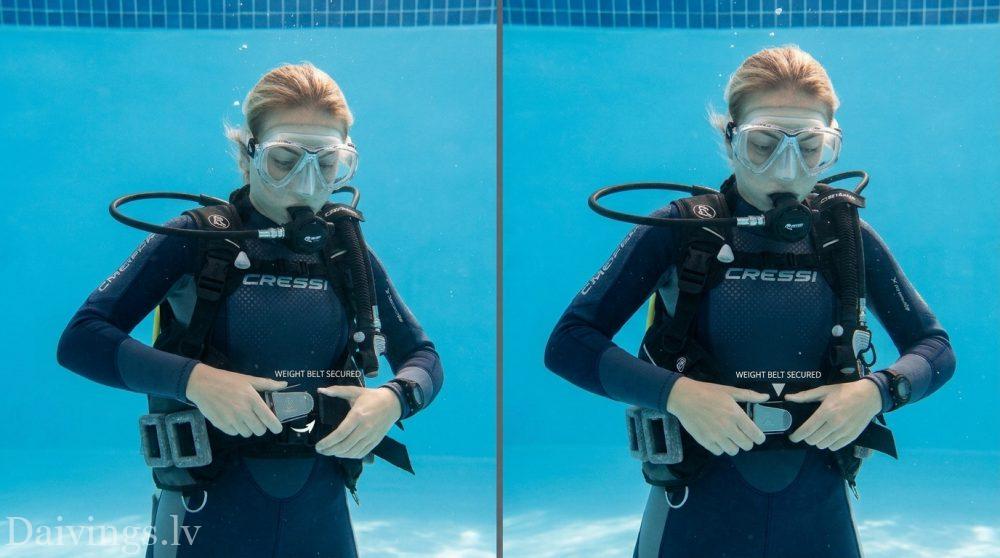
Under the instructor's guidance, remove all or part of your weight system underwater, keep it under control, and secure it back in place. The exercise is successful if the weights are securely in place, you continue to breathe calmly through the regulator, and you maintain control over your depth and body position. This skill is called Remove and replace weights underwater. It helps you become familiar with your equipment's fastenings and notice how shifting weights affects your balance.
What is the difference between a weight belt and integrated pockets?
With a weight belt, attention is focused on the buckle and ensuring that the belt can be freely removed and securely replaced. With an integrated system, attention is focused on the removable weight pocket and its locking mechanism on the buoyancy compensator. Before entering the water, the instructor demonstrates which part of the system you will use and how to check its fastening.
With a belt, a typical snag point is under an equipment strap or hose. If the buckle is open but the belt does not move freely, the instructor helps determine where it has caught. With an integrated system, the pocket may look fully inserted even though the latch has not yet engaged. If the pocket slides out when performing the check designed for that specific model, it is not yet securely fastened.
Some buoyancy compensators also have separate trim pockets. Before the exercise, find out which pockets are quick-release and which are intended for positioning weights to adjust your trim in the water.
What affects buoyancy and body position?
If you hand the weight to your instructor or lose it, it no longer pulls you down, so you may start to ascend. If you are still holding the weight in your hand, it continues to act on you, but shifting it to one side can alter your body position. For example, by removing a pocket and holding it out to the side, you might notice that one shoulder dips lower, even though your depth barely changes.
The instructor also observes what you are doing with your fins and how you are breathing while your attention is focused on the buckle or pocket. Continue breathing through your regulator during the exercise and, if you lose control, give the pre-agreed signal. Read more about buoyancy and other skills in the article about the most common beginner difficulties underwater.
Most common mistakes
| Observation | Possible cause | What to check with instructor |
|---|---|---|
| The buckle opens, but the belt gets caught. | The belt can be covered by an equipment strap or hose. | Belt placement and whether the path for removing the belt is clear. |
| The pocket slips out after insertion. | The pocket may be inserted incompletely, in the wrong direction, or with an unsecured latch. | The correct insertion direction and the manufacturer-specified locking check. |
| While holding the removed pocket, the diver tilts to one side. | The weight may be positioned too far to the side. | Hand placement, body position and initial weight distribution. |
| The diver begins an unplanned ascent. | Possibly, the diver is no longer holding the weight, initial buoyancy was too positive, or fin kicks are propelling them upwards. | At what point the change in depth began, who was holding the weight and how the fins were moving. |
Skill objective and observable outcome
The objective is to remove, replace and secure the designated part of the weight system while maintaining control over the equipment, depth and body position. Practise under an instructor's supervision in a swimming pool or other confined water environment. The instructor selects the starting position, depth and part of the system to be removed according to the course and equipment.
Keep the weights under control during the exercise. Dropping weights in an emergency is a separate skill with its own training objective. In this exercise, the instructor evaluates whether you:
- recognise the correct buckle or fastener and maintain your grip when releasing the weight system;
- continue breathing through the regulator and control your depth and body position;
- put the system back on and check that it is securely fastened.
Before the lesson, you can review diving skill guides in the app EasyPassScuba.
Frequently Asked Questions
What should you show your dive buddy if they use a different type of weight system? Before entering the water, show each other where the weights are located, which fasteners are quick-release, and how they work. For example, if your buddy has a single belt buckle, but you have two separately releasable pockets, show the release points for both pockets.
Next step
If you are a certified diver and wish to refresh this skill, sign up for an individual lesson with a Daivings.lv instructor and indicate in your application whether you use a weight belt or integrated pockets.