
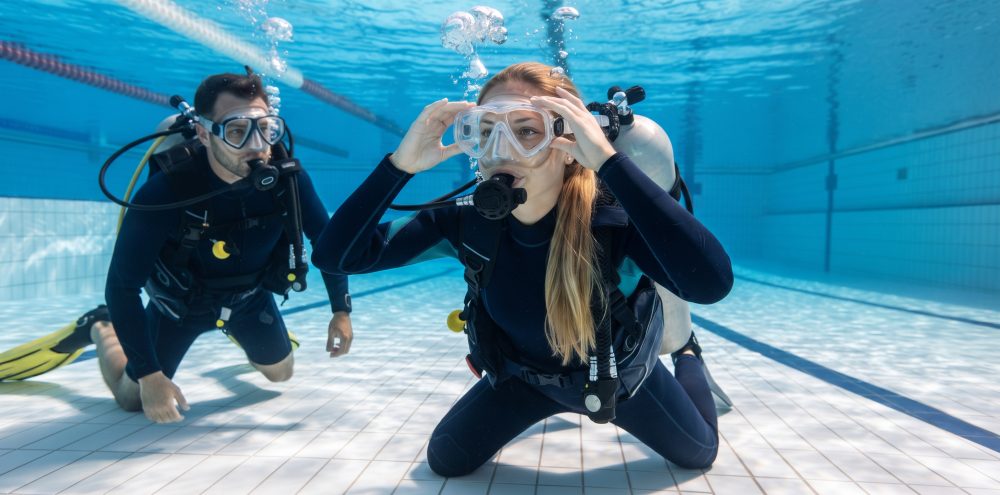
A partially flooded diving mask is cleared by exhaling through the nose while keeping the regulator in your mouth. You can often notice that a mask is partially flooded by a moving waterline near the bottom of the lens. This skill allows you to regain clear vision while keeping the mask on your face and maintaining depth control.
In English, this skill is called Clear a partly flooded mask. It is learned in the basic diving course, practicing with scuba gear under instructor supervision.
How to recognise a partially flooded mask?
A partially flooded mask contains both air and water simultaneously. For example, when turning your head towards your dive buddy, you may feel water slide along your cheek, or see a waterline moving along the bottom of the lens.
Fogging is usually seen as haze or tiny droplets on the lens. If your vision is blurred by haze, tips on preventing diving mask fogging.
How to clear water from the mask?
In a standard diving mask with a nose pocket and without a purge valve, exhaling through the nose pushes water out along the bottom edge of the mask. In the skill, the instructor shows how to lightly hold the top edge of the mask, look slightly upward, and exhale steadily through your nose. The regulator remains in your mouth, and the next inhalation is taken through the regulator.
For example, in a pool exercise, after exhaling, the waterline drops and disappears. If a little water remains, the instructor may ask to repeat the exhale and check head position and hand placement.
If your mask has a purge valve, the instructor will demonstrate the appropriate technique for that specific model. A full face mask requires separate training.
Why does water return after clearing?
If the mask is empty for a moment and then water flows back in, check how its silicone skirt seals against your face. For example, a strand of hair may be trapped under the skirt at the temples. A telltale sign is a waterline that disappears after exhalation and reappears moments later.
Together with your instructor, also check strap adjustment and mask seal with the regulator mouthpiece in your mouth. The mouthpiece changes facial shape, so a mask that fits well without it may fit differently while diving.
Most common mistakes
| Observation | Possible cause | What to check with instructor |
|---|---|---|
| Bubbles escape near the regulator, but the waterline in the mask does not move. | Exhalation is likely happening through the mouth. | How to steadily exhale through the nose after inhaling through the regulator. |
| During exhalation, bubbles escape near the forehead, and water remains in the mask. | Air is likely escaping along the top edge due to hand placement or skirt seal. | Where to lightly hold the mask and whether the upper skirt seals properly against the face. |
| The waterline disappears and returns shortly after. | There may be hair under the skirt, or the mask may not seal properly to the face. | The skirt, strap adjustment, and fit with the mouthpiece in place. |
| During the skill, the diver starts ascending. | Focusing on the mask, the diver may not notice the depth change or may start finning. | Initial buoyancy, body trim, and fin movements. |
Skill objective and observable outcome
The goal is to clear water while maintaining a calm breathing rhythm and depth control. The skill is mastered under instructor guidance in a shallow pool or another confined water environment with a suitable mask. Beginners learn this skill in the Open Water Diver foundation course.
The instructor can assess whether the regulator stays in your mouth at all times, the waterline disappears, the diver resumes calm breathing through the regulator, and maintains depth control during the exercise. If water in the face causes pronounced discomfort, give the agreed signal to the instructor to pause the skill.
Before the lesson, you can review diving skill guides in the app EasyPassScuba.
Frequently Asked Questions
Can I perform the skill with contact lenses? Tell the instructor before the session that you wear contact lenses. You can close your eyes during mask flooding and clearing. Agree in advance on the signals you will use during the skill.
Next step
If you are a certified diver and wish to refresh mask clearing, book a Scuba Review pool session with a Daivings.lv instructor.