
The Baltic Sea – the world's most unique underwater museum
The Baltic Sea is often referred to as the world's largest and best-preserved underwater museum among divers and researchers. Thanks to its unique conditions – due to the low salinity level, cold water and lack of oxygen at greater depths – the wood-eating worm does not live here (Teredo navalis), which destroys wooden wrecks in other oceans of the world within a few decades. As a result Merchant ships have remained virtually intact at the bottom of the Baltic Sea for hundreds of years, warships, and even evidence of ancient human settlements that sank as sea levels rose after the last ice age. Every dive in these waters is like a trip in a time machine.

Newly discovered archaeological sites deep underground
In recent years, thanks to the development of modern sonar and underwater drones (ROV), several breathtaking underwater archaeological sites have been discovered in the Baltic Sea. Researchers and enthusiasts have found both impressive wrecks of 17th-century Swedish imperial warships with ornate wood carvings, and merchant ships from the Hanseatic League (koge), whose holds still contain historic cargo. Much attention is also being paid to the sunken landscapes of the Stone Age, where the remains of ancient forests and traces of human settlements are found on the seabed. These discoveries are not only rewriting the maritime history of the region, but also attracting the attention of global scientists and passionate divers.

Preservation of underwater cultural and historical heritage
Underwater archaeology is not just an exciting adventure; it carries a huge responsibility. Every discovered wreck or artifact is a fragile piece of history. The main rule for divers near historical sites is: “Look, but don’t touch!” Arbitrarily raising archaeological objects can cause them irreparable damage, as wood or iron that has spent centuries underwater can quickly decay when exposed to oxygen and dried out. That is why modern underwater archaeology focuses on documenting, photogrammetry (creating 3D models) and mapping objects right where they are – on the seabed.

Skills needed for a deep sea explorer
To become a responsible underwater explorer and archaeological enthusiast, it is not enough to have ordinary diving skills. Explorers need perfect buoyancy control (so as not to accidentally stir up mud with their fins or damage fragile objects), the ability to navigate in difficult conditions, and the skills to work safely around a wreck or object. They also need to be able to recognize artifacts, understand their historical context, and learn methods for properly measuring and documenting underwater finds. It is this lack of specific knowledge that has historically been an obstacle to many divers engaging in serious research.

Exclusive underwater archaeology training in Latvia
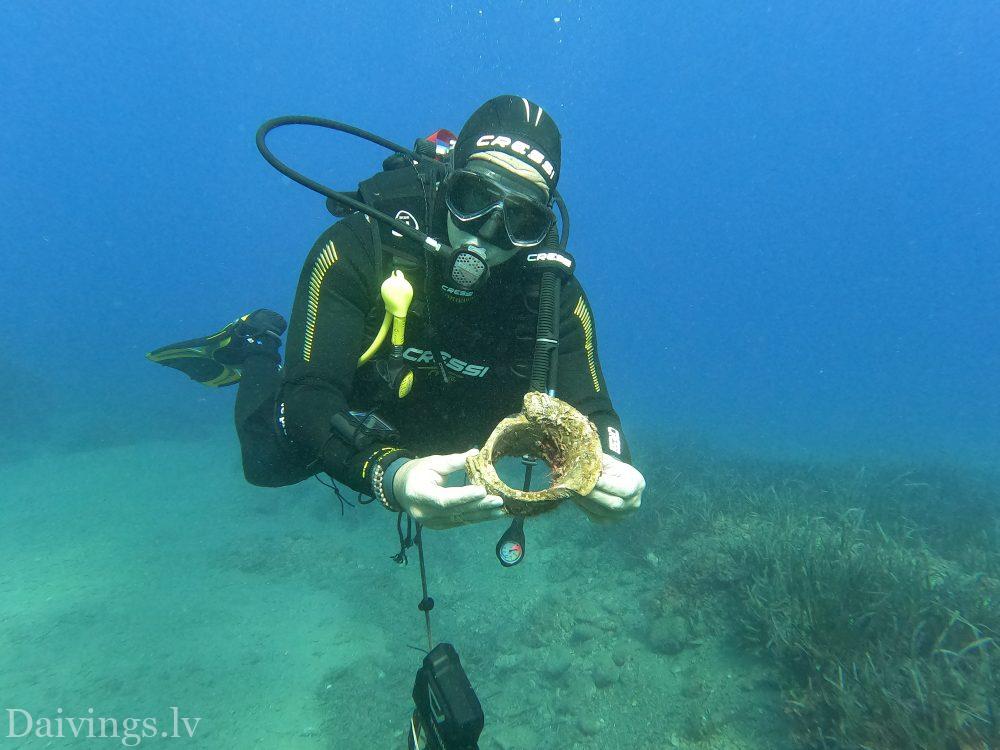
Latvian divers have a unique opportunity to learn these prestigious skills right here at home. Diving Club offers a specialized underwater archaeology course led by an experienced PADI and TDI/SDI instructor Valters Preimanis.
Valters Preimanis is one of the few professionals in the region who is able to train not only ordinary divers, but also instructors themselves in this specific and exciting field. He is certified PADI Underwater Archeology Diver Instructor Specialty instructor. In this course, divers learn techniques for searching for historical objects, documenting finds, the basics of underwater mapping, and, most importantly, a strict code of ethics for working with cultural heritage.

Your path to discovery with the Daivings.lv team
Becoming part of a team that explores and documents the secrets of the Baltic Sea is closer than ever before. By choosing to study the underwater archaeology specialization at the Valters Preimanis Club Diving Club As part of the program, you will not only gain an internationally recognized certification, but also open the door to a completely different dimension of diving. It is an opportunity to make a meaningful contribution to the preservation of history, participate in real research projects, and experience the joy of discovery by diving safely and responsibly to centuries-old, untouched secrets of the deep.
Underwater archaeological sites of the Baltic Sea

Because wooden wrecks are exceptionally well preserved in the Baltic Sea, the depths offer a unique insight into different periods of history.
Wrecks from the Swedish Empire and the Hanseatic League
- "Mars" (Makalös or the Mighty): A 16th-century Swedish warship that sank in 1564 during a massive naval battle off the island of Öland and was only discovered in 2011. It was one of the largest ships of its time. The wreck is extremely impressive - massive bronze cannons and the ship's wooden structures are still visible at the bottom.
- “Spökskeppet” (Ghost Ship): This 17th-century Dutch merchant ship (flute), located between Gotland and Estonia, gets its name from its near-undamaged state. The ship still has the remains of its masts and a large number of original details, making it one of the most breathtaking objects for researchers.
- “Virgin Mary”: A Dutch merchant ship that sank in the Finnish archipelago in 1771. It was carrying valuable cargo, including works of art intended for the Russian Empress Catherine the Great. This is one of the most thoroughly studied and famous underwater archaeological sites in the region.
Sunken Stone Age landscapes
- Haväng settlement (Sweden): About 20 meters deep in the Baltic Sea, researchers have discovered a remarkably preserved 9,000-year-old Stone Age landscape with tree trunks, branch structures and evidence of ancient human fishing gear. Such discoveries help scientists understand human life before the end of the last ice age, when sea levels were significantly lower.

The legacy of the First and Second World Wars
- The “ship graveyard” of the Irbe Strait and Cape Kolkas (Latvia): The Latvian coast is very rich in shipwrecks, as important trade and military routes passed through here. The region is home to dozens of 19th and 20th century wrecks, including warships, submarines and mine trawlers from World War I and II.
- World War II wrecks on the Estonian coast: Estonian waters, especially in the Gulf of Finland and around the islands of Saaremaa and Hiiumaa, are home to hundreds of ships that sank en masse in minefields during the evacuation of Tallinn in 1941. These metal giants and military equipment attract technical divers from all over the world.
- “Franken” (Poland): A German World War II supply ship that sank in the Bay of Gdańsk. It is a large and challenging wreck, but it also serves as a warning about ecological risks - the wreck still contains a significant amount of fuel, which is being closely monitored by researchers and ecologists.

Important note: Several of these objects are located at considerable depths, their coordinates are kept secret, or they are protected cultural monuments. Diving and studying them requires special state permits and a very high level of technical or archaeological training.


