
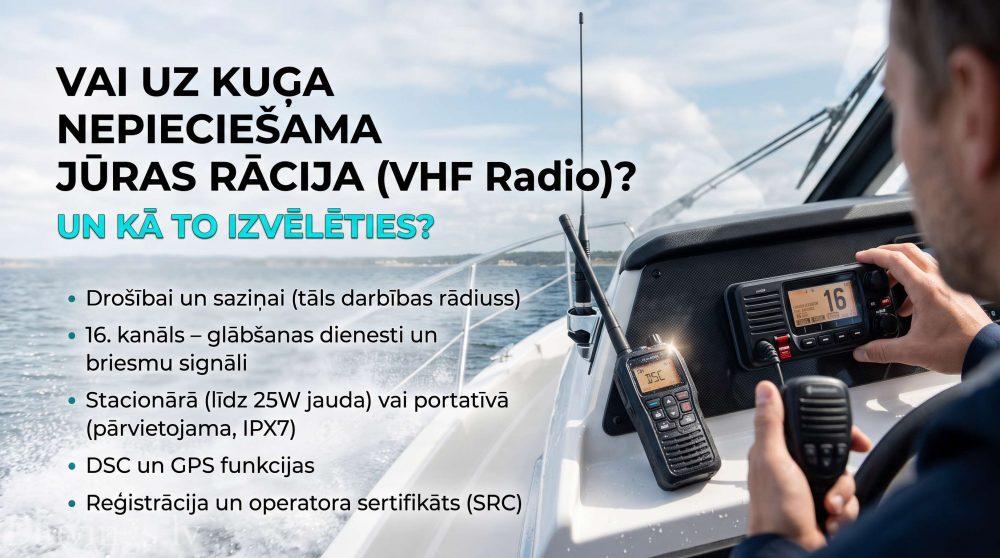
A marine radio, or VHF (ultra-shortwave) radio, is one of the most critical safety features on any vessel. Unlike a cell phone, which relies on cell tower coverage and only provides private two-way communication, a marine radio transmits on an open, public channel. This means that your message can be heard simultaneously by all nearby ships, boats, and shore rescue services.
In the event of an accident on the high seas, it is the line between a situation where the entire region immediately learns of your danger, and a situation where a cry for help goes unheard.
Latvian legal framework – when is a walkie-talkie mandatory?
The use of ship radio equipment in Latvian waters is strictly regulated by national regulations (available on the website laws.lv).
Authorization and unique MMSI number
In order to legally use a VHF radio on a vessel, the device must first be registered. A permit to use is issued and a unique MMSI number grants JSC “Electronic Communications”, based on the request of the shipowner and data from the Maritime Administration of Latvia or the CSDD. Operating radio equipment without a valid permit and call sign is a serious violation of radio regulations.
Equipment requirements according to Cabinet Regulation No. 30
The main reference point is Cabinet Regulation No. 30 “Rules for the use and maintenance of ship radio and navigation equipment”They determine the mandatory minimum radio equipment depending on the category of watercraft (which are defined in Cabinet Regulation No. 27):
- Category D (protected waters, bays, lakes): When the hull length reaches 12 m or more (as well as all category D vessels in port waters), at least one portable, splash-proof VHF radio with emergency communication capability on channel 16 is mandatory.
- Category C (coastal shipping up to 24 m): Must be equipped with fixed VHF radio equipment that supports DSC function on channel 70, as well as at least one portable radio. A NAVTEX receiver is also recommended.
- Category A and B (open sea and ocean up to 24 m): A more complete set of equipment is required: a stationary VHF with DSC, portable radios (according to the number of liferafts), MF/HF or satellite communication equipment, a NAVTEX receiver and an emergency position-indicating radio beacon (EPIRB).
- Vessels over 24 m: They are equipped with full GMDSS, similar to cargo ships.
Commercial ships and yachts
For commercial vessels and registered yachts, requirements are strictly controlled in accordance with Cabinet Regulation No. 49. “Regulations on the safety of ships”. Radio equipment is checked during annual technical inspections. If the radio does not work or is not certified, the seaworthiness certificate will not be extended.
Important: Periodic inspection of radio equipment (at least once every 3 years) may only be carried out by a merchant certified by the Maritime Administration of Latvia or a recognized classification society.
Operator Certificate (SRC)
To legally use a VHF radio with DSC function, the captain or operator needs Certified Short Range Operator Certificate (SRC)Without this certificate, the radio may only be turned on and used in case of real danger, transmitting MAYDAY call - at that moment any crew member may operate the radio.
Punishment and control mechanisms in Latvia
Responsible services — State Border Guard, Navy Coast Guard Service and Maritime Safety Inspectorate of the Maritime Administration of Latvia — conduct regular raids and inspections both in ports and coastal waters.
- Lack of registration: Using an unregistered walkie-talkie or transmitting without an approved MMSI number may result in a fine for violating radio communications regulations from the State Enterprise "Electronic Communications" and the State Police/Border Guard.
- Technical unpreparedness: Sailing without mandatory safety and radio equipment can lead to a ban on leaving port, cancellation of the seaworthiness certificate, and significant fines for the ship owner or captain.
- Fictitious distress signals: Unjustified or intentional transmission of a MAYDAY/DSC distress signal is subject to severe administrative and even criminal liability, including liability for the costs of calling rescue services.
What are DSC, MMSI, EPIRB and PLB?
| Designation | Full name | Main function |
| MMSI | Maritime Mobile Service Identity | A unique 9-digit ship “phone number”. Latvian codes start with 275 (e.g. MRCC Riga is 002750100). |
| DSC | Digital Selective Calling | Digital protocol to Channel 70When you press the red emergency button, coordinates and a distress message are automatically sent. |
| EPIRB | Emergency Position-Indicating Radio Beacon | Global emergency radio beacon (406 MHz) via COSPAS-SARSAT satellites. Automatically floats and activates when the ship sinks. |
| PLB | Personal Locator Beacon | Personal location transmitter. Attached to a life jacket, registered to the person, not the vessel. |
Radio distribution and practical operating distances
VHF radio waves propagate in line of sight, so The height of the antenna installation is often more important than the power of the device..
[Mast antenna: 10-15m] /\ / \ <--- (Creates a larger coverage radius) / \ ~~~~~~~~~~~~~~~~~~~/~~~~~~\~~~~~~~~~~~~~~~~~~~~~~~~ (Water level) [Walkie-talkie: 1.5m] \ o \ /|\ \
Stationary (fixed) radios
- Power: Up to 25 W (switchable to 1 W for close calls at ports).
- Power supply: Connected to the ship's 12V electrical system.
- Advantages: High mast antenna provides long range; integration with NMEA 2000 / GPS plotter.
Portable (handheld) radios
- Power: 5–6 watts.
- Power supply: Built-in battery.
- Advantages: Compact, mobile, indispensable as a backup device or communication device in a life raft.
Signal delivery in practice
| Connection type | Antenna heights | Approximate distance |
| Stationary ↔ Stationary | Mast 10–15 m ↔ Mast 10–15 m | 25-35 nautical miles (~45-65 km) |
| Stationary ↔ Coastal Station (MRCC) | Mast 10 m ↔ Coastal tower 30+ m | 30-50 nautical miles (~55-90 km) |
| Walkie-talkie ↔ Stationary | Person 1.5 m ↔ Mast 10–15 m | 5-10 nautical miles (~9-18 km) |
| Walkie-talkie ↔ Coastal station | Person 1.5 m ↔ Coastal tower 30+ m | 10-15 nautical miles (~18-28 km) |
| Walkie-talkie ↔ Walkie-talkie | Person 1.5 m ↔ Person 1.5 m | 1-3 nautical miles (~2-5 km) |
Note: Wind, large waves, rain and damaged cables reduce the distance. A properly selected, higher-mounted antenna increases the distance.
Specifics of walkie-talkies and underwater diving
Diving and working in open water pose additional risks that are not encountered in normal sailing. Therefore, a walkie-talkie plays a special role in organizing diving.
Dive Support Vessel
When organizing diving expeditions to sunken wrecks in the Baltic Sea or to more distant dive sites, a support boat (a speedboat or RIB boat) is the main safety island for divers.
- Streams and visibility: When surfacing further from the boat in the Baltic Sea due to strong underwater currents, a diver can quickly be blown beyond the line of sight. A support boat with a fixed radio and DSC should be ready to contact the Maritime Search and Rescue Coordination Centre (MRCC Riga).
- Diving accidents (decompression sickness, injuries): In cases of medical evacuation (MEDEVAC), channels 16 and 71 provide lightning-fast communication with the Coast Guard and rescue helicopters.
Waterproofing and safety equipment for divers
For divers and surface support teams, conventional radios will not withstand extreme conditions. This is where specialized equipment comes in handy:
- IPX7/IPX8 and floating cases: The hand-held radios intended for the diving support team must have the highest water resistance (SubmersibleMany modern models float when dropped into water and start flashing a bright LED light.
- Hermetic pressure containers (Dry Suit Canisters): Technical divers use special airtight containers made of aluminum or durable plastic, in which a small handheld radio or PLB transmitter is taken with you underwater (up to a depth of 40-60 meters). When surfacing in an unexpected place or away from the boat, the diver opens the container and can immediately send an alarm signal.
- Waterproof PLB attached to vest: A personal buoyancy aid (PLB) in a special waterproof case is the best insurance for solo divers and teams in the open sea.
Channels and services in Latvian waters
- Channel 16 (156.800 MHz): International distress, safety and call channel. All ships must ensure continuous listening (distress watch). International call sign on the Latvian coast: “RIGA RESCUE RADIO”.
- Channel 70: For digital DSC messages only (voice communications prohibited!).
- Channel 71: The main working channel of MRCC Riga. Official navigation and weather information is also broadcast here (MSI).
- Channel 6: Inter-ship security channel (Internship safety).
- Channel 13: Intership navigation safety, for wheelhouse with wheelhouse (Bridge to Bridge).
- Port working channels: Each port (Riga, Ventspils, Liepāja, Roja, etc.) has its own channels for the vessel traffic service (VTS).
Hydrometeorological announcements:
“RIGA RESCUE RADIO” Weather and navigation warnings are broadcast twice a day on channel 71: 07:03 and 15:03 (local time), with advance notice on Channel 16.
Checklist before going to sea
- Evaluate the vessel: Make sure your vessel category and size requires a fixed radio with DSC or if a handheld unit is sufficient.
- Register your device: Get MMSI and authorization JSC “Electronic Communications”.
- Provide GPS integration: Check that the stationary radio is receiving GPS data for accurate DSC calling.
- For diving trips: Provide the support boat with reliable communications and consider the use of airtight containers or PLBs for divers.
- Visit us: A complete and proven range of marine VHF radios, accessories and waterproof housings is available daivings.lv in the e-shop and in the salon.
Turning to daivings.lv specialists, we will help you find the most suitable model, antenna solution and the most suitable airtight housing for your diving and sailing needs!
Safety at sea starts with the right equipment.
Here is an updated section of the article with 5 Frequently Asked Questions and Answers (FAQ), which you can add at the end of the article:
Frequently Asked Questions (FAQ)
1. Can I use a regular handheld radio (PMR446 / Walkie-Talkie) for maritime communications?
No. Conventional PMR446 radios operate in a completely different frequency range, have very low power (0.5 W) and do not support international maritime channels (e.g. channel 16 or 70). They cannot communicate with maritime services or other vessels and provide a very short operating range on the water. For maritime communications, it is mandatory to use a certified VHF (UHF) marine radio station.
2. What to do if a DSC distress signal (Distress Alert) is accidentally sent?
If the DSC emergency button is pressed accidentally or by mistake:
- Immediately turn off transmission/cancel call in the device's own menu (if the radio has a cancel function).
- Switch to channel 16 and transmit a voice message addressed to all stations (“All Stations”), indicating the vessel’s name, MMSI number and clearly stating that the distress signal was sent in error and that there is no real danger.
- Also the Coast Guard (MRCC Riga) will receive this signal - if you are contacted by radio, acknowledge the error to prevent a false rescue operation from being initiated.
3. Can I use a radio with an MMSI number from another country if the vessel is registered in Latvia?
No, that's not allowed. The first three digits of the MMSI number (MID code, for Latvia 275) indicates the country under whose flag the ship is flying and in which it is registered. If the ship is registered with the Latvian Maritime Administration or CSDD, the MMSI number and permit must be obtained in Latvia — VAS “Elektroniskie sakaris”. Using an MMSI number of another country complicates the work of rescue services and is a violation of regulatory enactments.
4. How can I best protect my walkie-talkie or PLB transmitter while scuba diving?
Typical waterproof handheld radios (with IPX7/IPX8 standard) are designed for use on the surface of the water or for short-term immersion to a depth of 1-2 meters. To take your radio or PLB underwater (for example, when diving to a depth of 20-40 m):
- Use special aluminum or durable plastic airtight pressure containers (Dry Suit Canisters or Dive Canisters) that withstands pressure at the required depth.
- The container is opened only after surfacing, in case there is a need to call for help.
5. Do I need an SRC (Short Range Certificate) if I only use a walkie-talkie?
Yes, if the walkie-talkie is equipped with DSC function and is carried on board as a primary or backup means of communication. An Operator's Certificate (SRC) is required for anyone who operates or uses a ship's VHF/VHF radio with DSC function. The only exception is in a real emergency (MAYDAY), when anyone present may use the radio.